Causes and Lessons
By Víctor Velar, Jaime Peralta, Carlos Alvear, and Eugenio Quintana, Coordinador Eléctrico Nacional (CEN), Chile
At 15:15:41 local time on Tuesday, February 25, 2025, an intervention on the telecommunications module of a line protection system triggered the unexpected trip of both circuits of one of the main 500 kV transmission lines of Chile’s National Electric System (SEN). For approximately 1.5 seconds the system held together through a weak parallel 220 kV corridor; then the distance protection of that corridor operated and the SEN split into two islands. Within four seconds, the island carrying 70 percent of the country’s demand had collapsed. The northern island remained in service for about four more minutes before collapsing as well. Chile, which had not experienced a nationwide blackout in more than fifteen years, lost practically its entire supply of 11.7 GW.
This article summarizes what happened, why it happened, and what the event teaches the protection, automation, and control (PAC) community, based on the Coordinador’s fault analysis study (EAF 089/2025), the final report published in August 2025, and the system-level dynamic analyses carried out afterwards. Particular attention is given to the behavior of the 220 kV corridor protections during the 1.5 seconds between the initiating contingency and the system separation, a sequence involving distance elements, power swing blocking, and teleprotection, with lessons that extend beyond the Chilean system.
A Long, Narrow Grid in Transformation
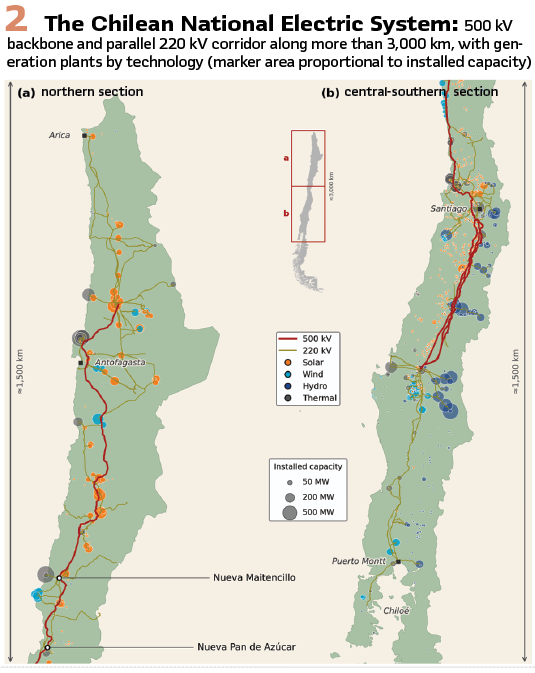
The Chilean National Electric System is shaped like the country itself: long and narrow, stretching more than 3,000 kilometers from the Atacama Desert in the north to the island of Chiloé in the south, with roughly 38,750 km of transmission lines. Its backbone operates at 500 kV, with a parallel 220 kV system running along most of the territory (Figure 2).
Chile is also undergoing a rapid energy transition. In 2024 the system served 85.5 TWh of energy with 36.8 GW of installed capacity and a peak load of 12.9 GW. Wind and solar supplied 33 percent of the energy, with instantaneous variable renewable energy (VRE) penetration peaking at 72 percent that year. The transition continued through 2025: by year-end, installed capacity had reached 39.2 GW, VRE supplied 38.4 percent of annual energy with an instantaneous penetration record of 79.4 percent, and distributed energy resources (DER) reached 3.9 GW, complemented by 2.5 GW of battery energy storage systems (BESS). National policy targets full retirement of coal from the generation mix by 2035 and carbon neutrality by 2050.
This transition brings the challenges familiar to the PAC community: declining system strength and inertia, faster system dynamics and control interactions, limited grid support from existing grid-following (GFL) inverter-based resources (IBR), immature standards for grid-forming (GFM) technologies, limited visibility and controllability of DER, and the growing gap between classic RMS simulation tools and the electromagnetic transient (EMT) behavior of a converter-dominated grid. All of these factors were present in the events of February 25.
System Condition Prior to the Event
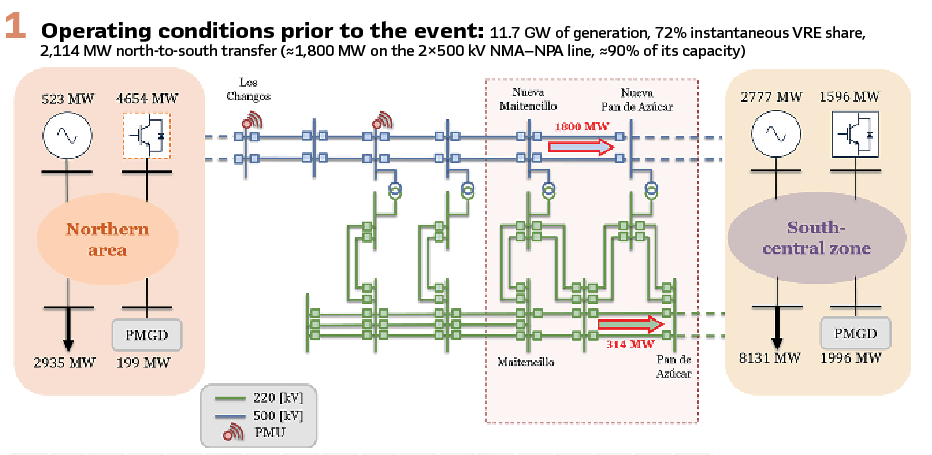
In the early afternoon of February 25, the SEN was operating in a stable, interconnected condition, in compliance with the N-1 security criterion. Generation stood at about 11.7 GW, with an instantaneous VRE share of 72 percent. As is typical at midday, generation was concentrated in the north — mainly solar and wind, essentially all grid-following IBR — while the central and southern regions relied on the north-to-south transfer, complemented by local solar and wind, hydro, thermal units, and DER (Figure 1).
The total north-to-south power flow was 2,114 MW. Approximately 1,800 MW flowed through the double-circuit 500 kV Nueva Maitencillo – Nueva Pan de Azúcar (NMA–NPA) line — about 90 percent of the line’s capacity — and roughly 300 MW flowed in parallel through the 220 kV corridor.
The Triggering Event
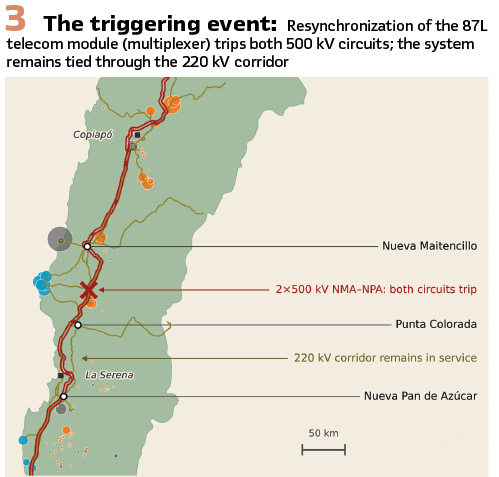
At 15:15:41 local time, personnel performed an intervention to resynchronize the telecommunications module (multiplexer) of the 87L line current differential protection of the 500 kV line. The intervention caused the unexpected, simultaneous trip of both line circuits (Figure 3).
Two aspects deserve emphasis. First, there was no primary fault on the power system: the double-circuit outage, a severe N-2 contingency on the most heavily loaded corridor of the grid, originated entirely within the secondary systems, from a single intervention on protection communications equipment. Second, the event exposed a condition in the protection communications scheme: a single intervention on shared telecommunications equipment affected the line differential protection of both circuits, a common point of failure that the independence and redundancy requirements between protection systems are meant to prevent. The asset owner was subsequently instructed to modify the design to meet those requirements.
The triggering event is a reminder that the availability and maintainability of protection communications are as much a part of system security as the relays themselves, and that maintenance and resynchronization work on in-service teleprotection and 87L channels should be planned and executed with the same rigor that is applied to switching operations on primary equipment.
Power Swing Analysis on the 220 kV Corridor
With both 500 kV circuits open, the 1,800 MW that had been flowing on the NMA–NPA line transferred to the only remaining path: the parallel 220 kV corridor, already carrying about 300 MW and not designed for a transfer of that magnitude. The result was a severe power swing between the northern and central-southern parts of the system, with the electrical center of the oscillation located on the surviving 220 kV tie.
The separation point was the double-circuit 220 kV Nueva Pan de Azúcar – Punta Colorada line. The analysis that follows is based on the oscillographic (COMTRADE) records of the numerical protection relay of the circuit 1 bay at Nueva Pan de Azúcar substation (breakers 52J8 and 52J9). The line protections comprised distance protection (ANSI 21) with phase-to-phase Zone 2 elements; power swing blocking (ANSI 68), which detects a swing by measuring the transit time of the impedance through the band between its outer and inner characteristics; and a permissive overreaching transfer trip (POTT) teleprotection scheme. The sequence of operations unfolded over three successive swing cycles. (Figures 4 and 5).
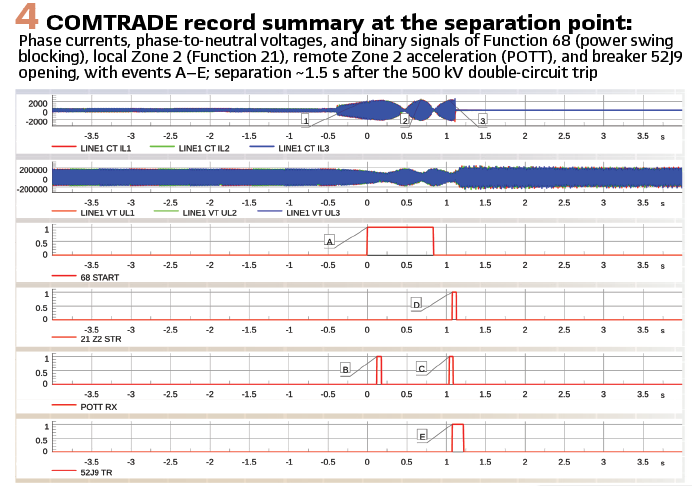
Oscillations 1 and 2: As the first swing developed, the apparent impedance trajectory entered the Zone 2 characteristic. The power swing blocking function correctly detected the swing and blocked the local Zone 2 distance element (Event A). At the same time, the remote terminal’s Zone 2 acceleration (POTT permissive) signal was received (Event B). With the local element blocked, no trip resulted: through two full swing cycles the protection restrained correctly.
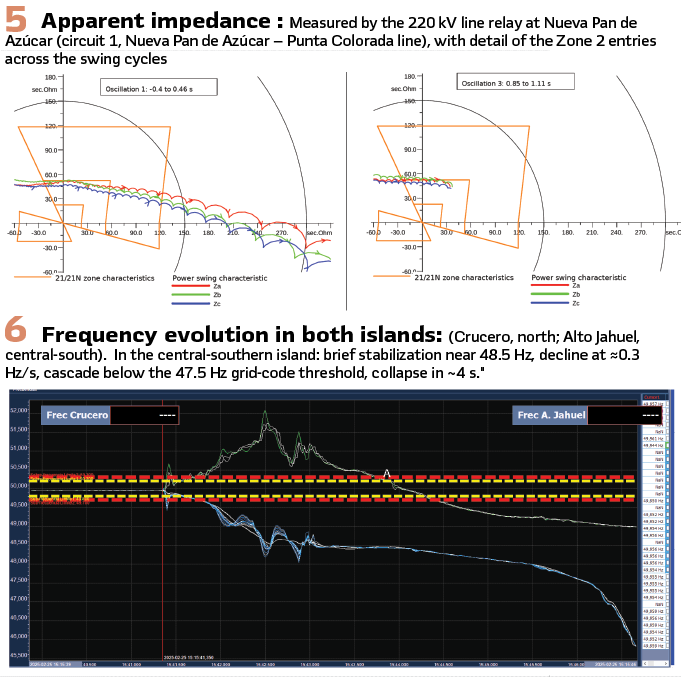
Oscillation 3: The swing detection was based mainly on the behavior of the first oscillation. Because the transit speed of the impedance changed significantly during the second and third oscillations, Function 68 ceased to block Function 21. As the impedance re-entered Zone 2 during the third oscillation, the local element issued a Zone 2 trip order (Event D) which, combined with a new Zone 2 acceleration signal received from the remote terminal (Event C), satisfied the POTT logic and opened breaker 52J9 (Event E). The system separated into two islands — approximately 1.5 seconds after the loss of the 500 kV circuits.
The impedance records of this sequence are among the most instructive results of the event analysis. Each element behaved according to its settings and design philosophy; there was no misoperation, but correct execution of the configured protection logic does not by itself imply that the resulting system-level response was desirable. The outcome was a system separation at a point and time determined by the relays’ response to the swing rather than by a deliberate separation design, after 1.5 seconds of severe power and voltage oscillations that stressed generators across the grid and preceded the collapse.
This sequence also raises a broader question of protection philosophy, offered here as a general observation rather than as a finding of the event investigation. As system inertia declines and swing trajectories become faster and less regular, the classical assumptions behind power swing blocking settings need to be reviewed, together with the behavior of permissive teleprotection schemes when both line terminals measure swing impedance instead of fault impedance. A more basic question is whether line distance elements should perform the system separation at all. Deliberate alternatives exist: out-of-step tripping (ANSI 78) at selected network locations, or, for a defined critical contingency, event-driven system integrity protection schemes (SIPS) that detect the loss of the corridor and execute a controlled split at pre-studied points, with the resulting islands balanced by design, within a few hundred milliseconds and before an electromechanical swing of this kind can develop to dangerous levels.
The Chilean system had anticipated this scenario. As early as 2020, the Coordinador instructed the implementation of such a scheme: an automatic system-separation SIPS for the northern zone, conceived for severe double contingencies on the critical north–south corridor and designed to execute a controlled split within a fraction of a second, before a swing sequence of this kind can develop. As of February 25, the scheme was simply not yet complete; its implementation is now under way, with entry into service scheduled for 2027. The 220 kV protections performed correctly and separated the system into two islands. That correct protection performance, together with the grid code compliance that should have existed in generator ride-through behavior and in the load-shedding scheme, would have been sufficient to prevent the total collapse, as the simulations presented later in this article show. The separation scheme now being implemented will make that split faster and controlled; what was missing on February 25, however, was compliance rather than the scheme.
Islanding and Collapse
The separation created a northern island with roughly 30 percent of the demand and a central-southern island with the remaining 70 percent. The 1.5-second interconnected interval had already triggered severe power and voltage oscillations, activating both over-frequency generation-shedding and under-frequency load-shedding (UFLS) resources across the system (Figure 6).
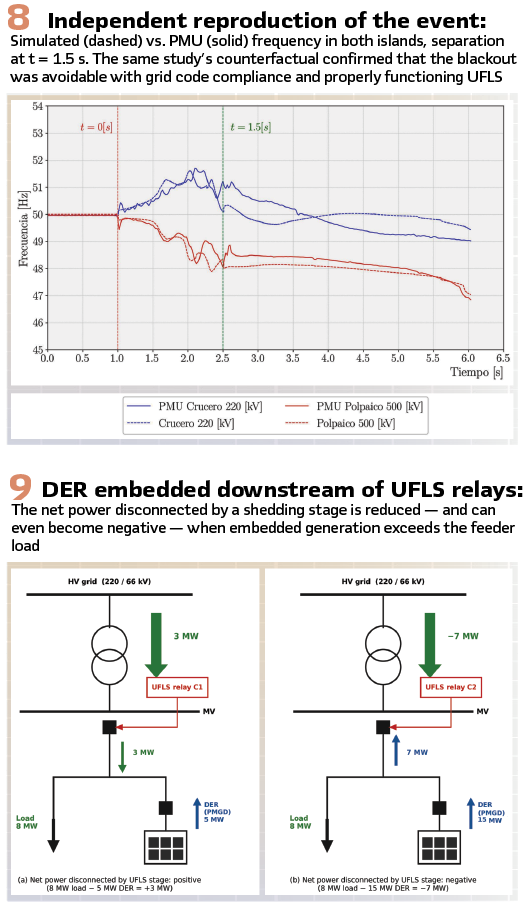
The central-southern island, which was importing before the split, collapsed in about four seconds. Frequency fell rapidly, due to the loss of the northern infeed and to generation behavior that violated grid code requirements: around 1,450 MW of generation disconnected earlier than the frequency and voltage ride-through requirements allow. The under-frequency load-shedding scheme, in turn, shed less load than designed, largely because of DER. In many distribution feeders, generation connected downstream of the UFLS relays reduced the net load actually shed when those relays operated, so each shedding stage removed less demand than the defense plan assumed. Frequency stabilized briefly near 48.5 Hz, then drifted down at roughly 0.3 Hz/s toward 47.5 Hz — the threshold below which the grid code permits generating units to disconnect. Once 47.5 Hz was crossed, additional generator trips cascaded, and the island lost all supply. Voltages in the island rose moderately after the separation and remained elevated throughout the event.
The northern island, which had been exporting and was dominated by GFL solar and wind generation, faced the opposite problem: overvoltage. With the lack of dynamic voltage control from IBR plants and the loss of reactive compensation, voltages rose sharply within the first 1.5 seconds and remained above alert thresholds.
Generators and other installations tripped on overvoltage both before and after the islanding. The island nevertheless held for about four minutes before collapsing on low frequency.
Event Simulation
To assess whether the islands could have survived, the Coordinador reproduced the event with system-level RMS dynamic simulations, benchmarked against PMU recordings (Figure 7: measured response in red, simulated in green). The reproduction of the actual event confirms the diagnosis: early generation disconnections in violation of ride-through requirements, plus the degraded effectiveness of UFLS due to DER, drove the central-southern island into collapse.
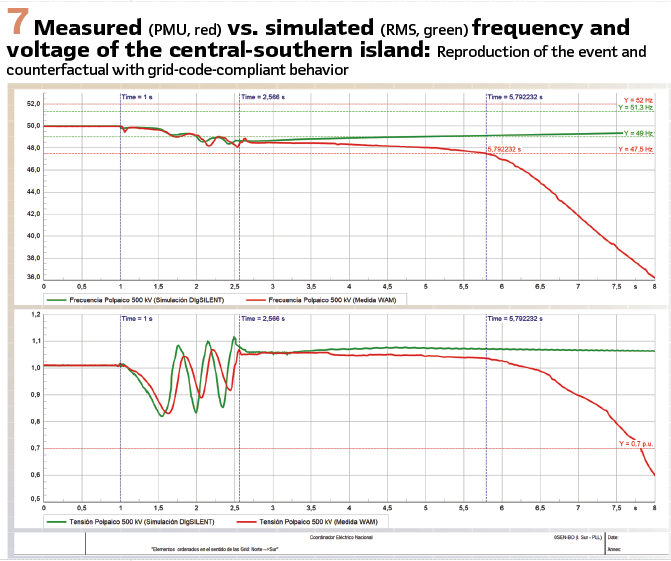
The counterfactual simulation is the more important result. If all generating units had complied with the grid code’s frequency and voltage ride-through requirements, and if the UFLS scheme — including its interaction with DER — had delivered the load relief assumed in its design, frequency and voltage in the central-southern island would have stabilized. The island carrying 70 percent of national demand would have survived, and February 25 would have been a serious but partial event confined to the north.
An independent study conducted by a consortium of Chilean universities reached the same conclusion (Figures 8 and 9). The full analyses are documented in the fault analysis study EAF 089/2025 and in the Coordinador’s final report published in August 2025, which is publicly available on the Coordinador’s website.
System Restoration
The restoration process produced its own lessons, related to the infrastructure that recovery depends on. Several black-start facilities failed to synchronize to the grid, delaying the process. Several SCADA systems supporting the Regional Restoration Operation Centers (CORs) — restoration control centers operated by the transmission companies, which provide the Coordinador’s dispatch center with network visibility and communication channels during recovery — failed during and after the collapse, causing loss of visibility and controllability of the black-start process and of transmission facility status. One of the largest transmission companies lost its SCADA for about three hours (Table 1).
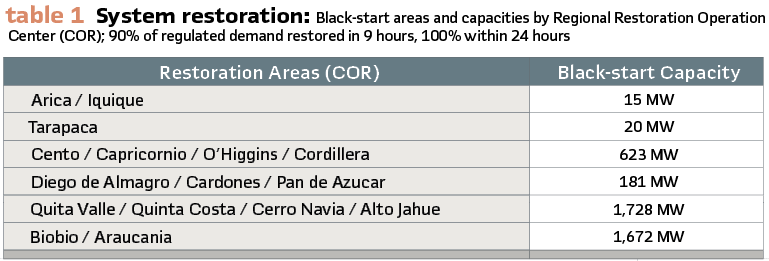
Even so, 90 percent of regulated demand (residential and small commercial customers) was restored within 9 hours, total demand was recovered within 24 hours, and the service recovery plan (PRS) was formally concluded at 08:40 on February 26. The event made clear that restoration plans depend on the telecommunications, SCADA, and black-start resources they assume, and that those assumptions must be verified periodically.
Measures Adopted Post-event
In the weeks following the event, the Coordinador issued a set of urgent instructions and measures, among them: correcting the generation plant settings that caused unexpected trips; performing technical inspections at the affected facilities and normalizing their protection schemes, including replacement of the failed communications module; instructing DER plants to verify and correct protection settings in accordance with the grid code; requiring information on UFLS resources and the normalization of settings and configurations affected by DER; submitting the fault report study (EAF) to the authority and reporting all grid code non-compliances to the Superintendency of Electricity and Fuels (SEC), the sanctioning authority; instructing the transmission owner to redesign its communications scheme to comply with independence and redundancy requirements; proposing regulatory modifications on GFM and GFL inverter requirements and new visibility and controllability requirements for DER; initiating technical audits of transmission owners’ protection, SCADA, and communications systems; and launching a review of the methodologies and resource adequacy of the load-shedding, contingency defense, and system recovery plans. Two independent studies — by an international research institute and by a consortium of Chilean universities — were also commissioned.
In the medium and long term, the measures address the operating conditions of a converter-dominated grid: enhanced operator training and testing of recovery plans; integration of dynamic voltage control from GFL VRE and BESS plants; review of remedial action schemes to incorporate fast voltage control using grid-forming technologies; a systematic update of RMS models and accelerated delivery of EMT models for IBR facilities; and the incorporation of advanced EMT dynamic security assessment (DSA) platforms into control room operations.
Lessons Learned: Four lessons stand out from February 25:
Compliance is a system property. The initiating event of the blackout was not caused by the energy transition. The collapse propagated through a chain of non-compliances in generator ride-through behavior, in DER protection settings, and in the configuration of load-shedding resources. Simulations show the central-southern island survives if the grid code requirements are met. As the energy transition reduces system robustness and operating margins, disturbances and non-compliances that might previously have remained contained can propagate more widely. This makes strict compliance, verified and enforced, one of the highest-leverage reliability measures available.
Secondary systems can be the initiating event. The disturbance began with a maintenance action on a protection multiplexer and concluded with the correct operation of distance relays. Protection, teleprotection, SCADA, and their communications require design criteria of independence and redundancy, and operational procedures commensurate with the primary-system consequences of their failure.
Defense plans must be designed for today’s grid. Power swing blocking philosophies, separation strategy, UFLS staging, and restoration plans were all conceived for a synchronous, centrally supplied system. Fast swings, GFL voltage behavior, and DER embedded below UFLS relays changed the assumptions. The 220 kV protection records of February 25 show why these schemes must be reviewed deliberately instead of being left to operate incidentally. In Chile that review was already under way years before the event, with the separation scheme instructed for the northern zone as the clearest example, and February 25 confirmed its urgency.
IBRs are part of the solution. A converter-dominated system has lower system strength and faster, deeper dynamics. The same resources that today provide limited support can, with adequate requirements and technologies (dynamic voltage control, grid-forming capability, visibility and controllability of DER), become central to preventing future blackouts and to accelerating recovery.
The Coordinador’s commitment after February 25 is that this type of event shall not happen again. The technical, regulatory, and procedural work described here supports that commitment.
Biograpies:

Victor Velar holds a degree in Civil Industrial Electrical Engineering from Pontificia Universidad Catolica de Chile. From 2000 to 2015, he directed Latin American transmission studies at ENDESA-ENEL, and since 2015 he has led the Electrical Studies and Real-Time Simulation Laboratory at CEN, where he is Deputy Manager of Studies and Real-Time Simulation. He currently works on the integration of inverter-based resources into the Chilean power system, with emphasis on grid-forming verification, EMT studies, HIL testing, and system strength assessment under high renewable penetration. He has contributed to the development of Chilean regulation and grid code on these matters.

Jaime Peralta received his B.Sc. degree in electrical engineering from the University of Chile in 1994 and completed his M.A.Sc. and Ph.D. degrees at Polytechnique de Montréal, Canada, in 2007 and 2013, respectively. He joined Chilquinta in 1994, where he held different positions in the operation and planning groups. He worked as Senior Power Systems Engineer at CYME International and as Strategic Planning Leader at BC Hydro. He was also Senior Manager at Siemens PTI Canada and Power Systems Manager at Alstom Grid in Philadelphia, USA. He is currently a Member of the Board of Directors at the Coordinador Eléctrico Nacional, Chile’s independent system operator.

Carlos Alvear received his degree in electrical engineering from the University of Chile in 2004. His professional experience focuses on power system studies, electrical protection, and technical and regulatory analysis. His expertise includes power system modeling, dynamic simulation, automation, and data analysis. He currently works at the Coordinador Electrico Nacional.

Eugenio Quintana received his B.Sc. degree in electrical engineering from the University of Chile, Santiago, Chile, in 2012. From 2012 to 2014, he worked at Systep. Since then, he has worked at the Coordinador Electrico Nacional, the Chilean system operator, where he currently serves as Head of the Power System Studies Department. His research interests include power system stability, power system protection, system strength, and ancillary services.