by Wayne Hartmann, GE Vernova, USA
With the fast-tracked planned installations of Utility-Scale Inverter-Based Resource (IBR) Power Plants to the bulk power system, utilities, consultants, EPCs and developers are all seeking methods to standardize P&C designs to hasten project execution. Many of these power plant designs incorporate a high voltage (HV) section or sections, pooling bus (PLB) section or sections and collector bus (CLB) sections.
This article explores a typical utility-scale photovoltaic IBR power plant incorporating all these sections and suggests architectures for standardized yard-to-merging unit connectivity. Also addressed is the use of partially centralized protection solutions to further increase standardization and hasten project execution.
As most of these power plants follow standardized approaches for the power infrastructure, the protection and control also can provide a high degree of standardization
CLBs and PLBs are used in renewable power plants such as wind or photovoltaic (PV) power stations to manage the power flow from the generation source to the transmission grid.
In these distributed generation projects, power is produced by many individual sources, like wind turbines or solar panels. Each of these sources generates a relatively small amount of power at low voltage or lower medium voltage level (480V-4.160V).
The collector substation aggregates this power and combines into a major block of power at a higher medium voltage (13.8kV-69kV). These major blocks of power are then combined into an output that can be fed into the transmission grid at HV level (115kV-230kV+).
Without CLBs and PLBs, it would be difficult to manage and utilize the power generated by these distributed sources. CLBs and PLBs serve as critical links between the renewable power sources and the main power grid.
Factors to consider in CLB and PLB designs are:
- The design seeks to minimize losses, and voltage drops within budgetary constraints
- Factors considered in interconnecting cable design cost, real power losses, and voltage drop. A typical design goal is to keep average real power losses below 1%. At full output, real power losses can be as much as 2 to 4%. Interconnecting cabling from IBR sources to the collector buses and to step up transformers between the collector and pooling buses is typically underground
- Metal-clad switchgear in weatherproof enclosures is often used for CLBs at 15kV and below
- PLBs, at higher medium voltage levels, are typically outdoor air insulated design using vacuum breakers
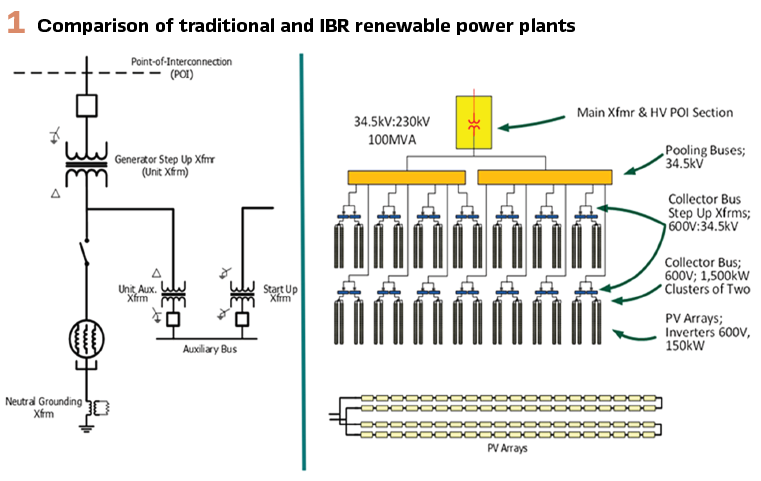
In Figure 1, we compare and contrast a traditional Utility-scale powerplant with a single power source and an IBR renewable plant with the 100s of smaller energy sources.
Example Utility-Scale IBR Renewable Plant
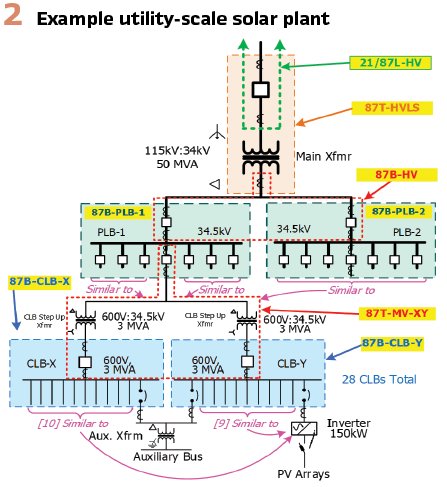
An example – Utility-Scale Solar Plant is shown in Figure 2. The plants’ various buses and voltage levels are listed below:
- Two PLBs are used, each with seven sources. AIS, Outdoor CBs.
- The PBLs are identical
- Seven identical sources each PLB input
- The 28 CLBs are identical. LV Switchboards in weather-proof enclosures
- CLB connections are 10 150 kW, 600V inverters, a feeder to supply auxiliary power, and one output to CLB Step Up Xfmr
- Two CLBs are grouped per PLB input
- Two PLBs input into the Main Xfmr
We will make use of the standard infrastructure topology to develop a standard approach to the protection schemes using Digital Substation techniques.
Protection Philosophy and Design
An economic protection method to employ with the Collector and Pooling Buses is the use of partially centralized systems. Partially centralized systems combine an element suited for a given zone or zones of protection, plus multizonality, that is, protecting different zones with the same protection system.
For our study, we will assume use of two protection systems for application in partially centralized distribution protection schemes:
- A transformer protection system that can cover <=6 nodes, employing a definable and selectable transformer differential zone, with all nodes employing overcurrent, voltage and frequency elements. This is referred to as System #1
- A combination bus/feeder, main, tie CB protection system that can cover <=28 nodes of primary bus differential protection with phase and neutral/ground overcurrent, overvoltage, neutral overvoltage and breaker failure protections for each node. The differential protection may be divided into <=3 zones. This is referred to as System #2
Single line drawings (SLD) of two systems follow in Figures 3, 4, 5, 6.
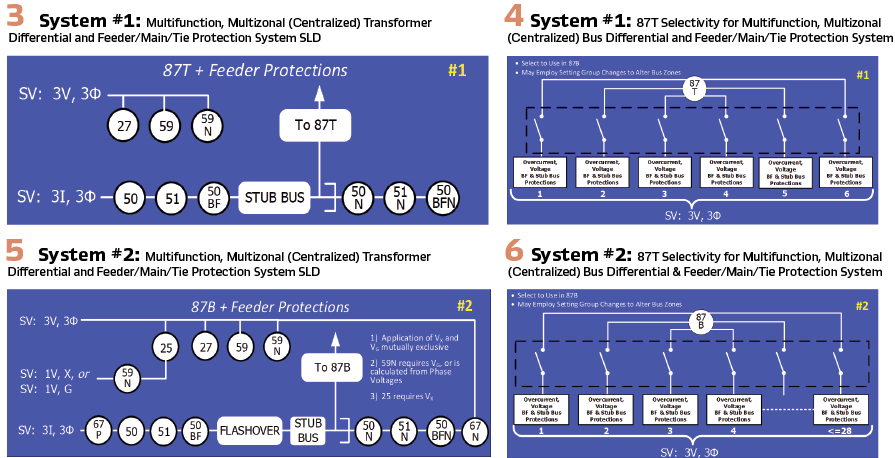
Bus Differential and Feeder/Main/Tie Protection System
Referencing Figure 2, description of infrastructure and protection application:
- For CLB Main CBs, and the cabling to the Main Xfmr low side CTs, one System #2 will cover two CLBs Main CBs, cabling to the Main Step Up Xfmr low side winding
- For the Main Xfmr, two System #1 will provide redundant coverage
- For the HV Utility POI, two-line protection systems will provide coverage
- Six MUs will be used to provide redundant HV POI Line Protection, redundant Main Xfmr Protection and non-redundant PLB to Main Xfmr low side bus protection

This will be shown in detail from the CLB to the Utility POI.
MU Connectivity and Protection: CLB
Referencing Figure 7, for CLBs, System #2 will cover two CLBs. Description of infrastructure and protection application:
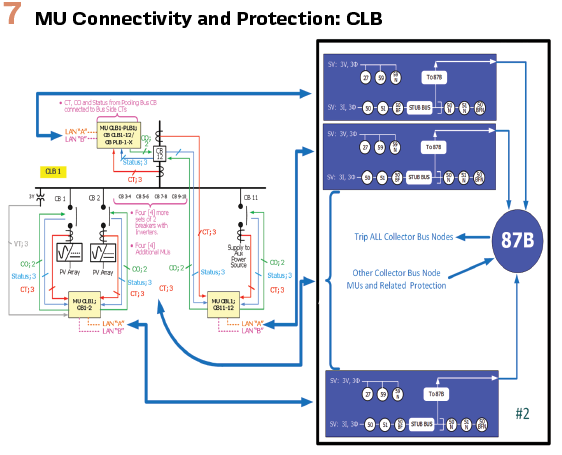
- Seven groups of two CLBs per PLB input, 2-CLBs connected to each PLB
- Each CLB has 10 Inverters, One Auxiliary Source and one Main as nodes (12 nodes total)
- Overcurrent, voltage and breaker failure protection provided for all nodes
- Each CLB is a 12 node 87B zone, 87CLB-X and 87CLB-Y
- Total nodes used by CP#2 = 12+12 = 24 (<=28)
- Non-redundant protection for the set of two CLBs will require one Protection System #2
- Non-redundant protection for the set of two Collector Buses application will require 14 MUs.
- For nodes on the CLB, System #2 provides bus differential protection. For a bus differential trip, all CBs connecting the CLB are tripped
- A BF of the Main CB will be cleared by an upline PLB input CB
Note: All MU-Relay signals through networked connection. Connections shown here are to show relationships only.
MU Connectivity and Protection: CLB to PLB, CLB 87B
Referencing Figure 8, for the two CLB Main CBs and the PLB input CB, System #1 provides overcurrent, voltage and BF protections. The respective CB is tripped for any protection trip. In the case of BF, all CBs connecting the CLB are tripped.
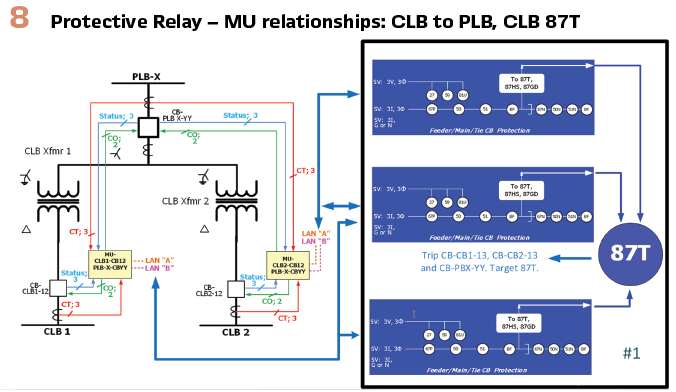
For the zone between the two CLB CBs and PLB input CB, System #1 provides transformer and cable differential protection. For a transformer or cable differential trip, two CLB CBs and PLB input CB tripped.
A BF of a PLB input CB will clear the respective PLB.
MU Connectivity and Protection: PLB
Referencing Figure 9, for the PLB Input and Main CBs, System #2 provides overcurrent, voltage and BF protections. The respective CB is tripped for any protection trip. In the case of BF, all CBs connecting the PLB are tripped.
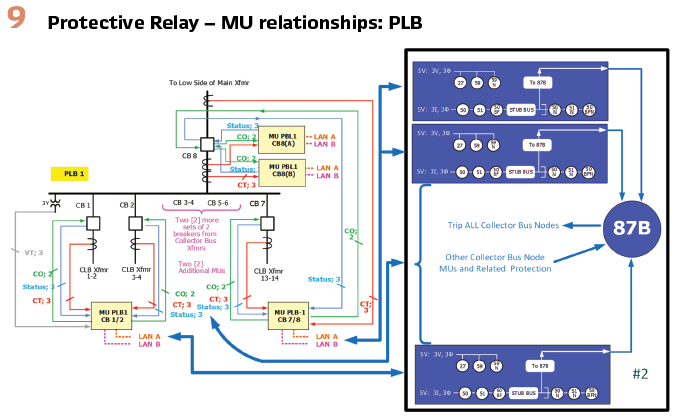
For nodes on the CLB, System #2 provides bus differential protection. For a bus differential trip, all CBs connecting the CLB and PLB tripped.
A BF of a PLB Main CB will trip CB M.
System #2, will cover two CLBs Description of infrastructure and protection application:
- Yard to MU Connectivity for PLB 1; PLB 2 is similar
- Non-redundant protection for the set of two CLBs will require one Protection System #2
- Total nodes used by CP#2 = 8+8 = 16 (<=28)
- Non-redundant protection for the set of two Collector Buses application will require 8 MUs.
- Redundant MUs on PLB Main CB bus side as they are part of the Main Xfmr 87T (HV, NERC)

Protective Relay – MU Relationships: Main Xfmr 87T
Referencing Figure 10, for the two PLB Main CBs, System #2 provides overcurrent, voltage and BF protections. The respective CB is tripped for any protection trip. In the case of BF, all CBs connecting the PLB are tripped.
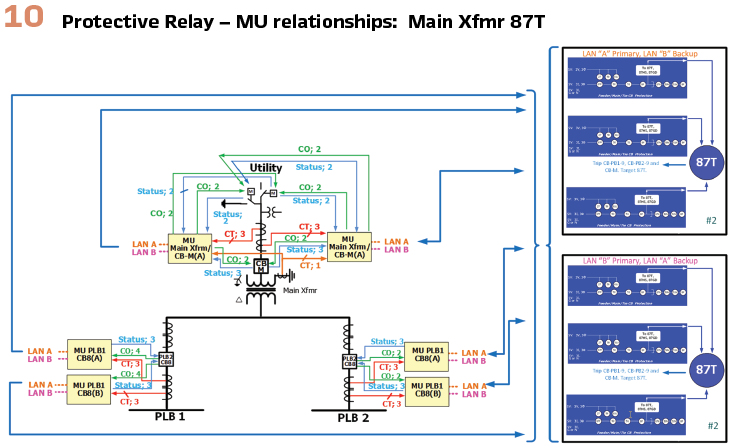
For the two PLB Main CBs, cables between the PLB and Main Xfrm, the Main Xfmr, and CB M, System #2 provides bus differential protection. For a bus differential trip, all CBs connecting the PLB and the Utility POI (Main CB) are tripped. Two System #2’s are used for required redundancy.
A BF of a PLB output CB will clear the respective all PLB CBs. A BF of CB-M will transfer trip to upline transmission system CBs.
MU Connectivity and Protection: Utility POI
Referencing Figure 11, for the CB M, the Utility POI, dual line protection systems are employed. Exact element fleet and principle used are dependent on the Bulk System Owner. CB M is tripped for any line protection that trip in either redundant protection system.
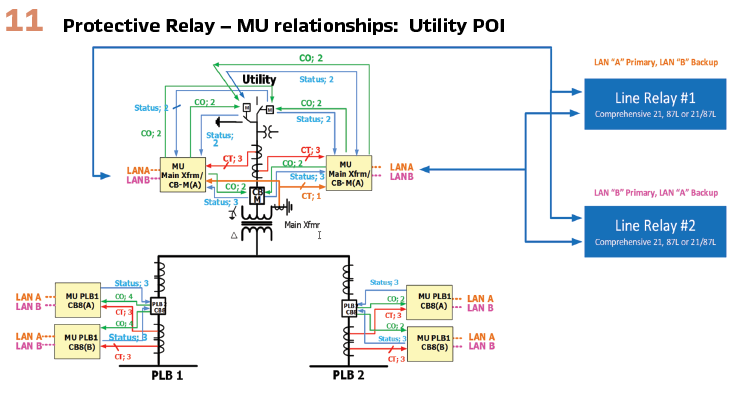
A BF of CB-M will transfer trip to upline transmission system CBs.
Conclusions
- In some Utility-Scale IBR Renewable Plants, there may be high quantity use of granulized and repeated power infrastructure
- These designs lend themselves to the use of centralization for a high degree of standardization in the P&C design
- Savings on the quantity of protective devices, quantity of panels and space inside the control house can be obtained
- In Greenfield applications, MUs can often be housed in breaker cabinets and LV switchgear compartments, with attendant enclosure and civil savings. As one of its attributes, centralization allows economical application of primary and backup functions
- In Greenfield applications, MUs can often be housed in breaker cabinets and LV switchgear compartments, with attendant enclosure and civil savings
- A large amount of standardization can occur from the standardized design and fabrication of MU enclosures (if applied)
- Wiring runs from MUs to the yard elements are short and standardized
- It is possible to protect high node count buses using process bus enabled protection
- It is possible to economically deploy cable differential protection using sampled values from cable terminals and defining the cable as a bus zone
- If the MU information for all accessed points is brought into the control house, the Operators have full view of every element off the plant, from the high voltage POI to the individual inverter AC inputs, without having to travel to various areas of the plant.
Biography;

Wayne Hartmann, is Advanced Applications Advisor for GE VERNOVA, Grid Automation. He explores the application of new technologies in P&C with Electric Utilities, Industrials and Consultants. He provides market research, ideation for new product development and supports the Sales and Application Teams.
Wayne was in Standards Development at Duke Energy, and in Application, Sales and Marketing Management capacities at Beckwith Electric, PowerSecure, GE, Siemens Power T&D and Alstom T&D.
Wayne is a Life Senior Member of IEEE and serves as a Main Committee Member of the PSRC for over 30 years, contributing to Standards, Guides, Reports and Tutorials.