by Alex Apostolov, USA
Fault and disturbance analysis has always sat at the heart of power system protection engineering. When a breaker trips, a relay operates, or a transient ripples through a network, disturbance recorders, digital fault recorders (DFRs), and protection IEDs capture waveforms, sequence-of-events data, and oscillography that engineers must interpret to determine what happened, why, and whether the system responded correctly.
For decades this has been a manually intensive process: pulling COMTRADE files, overlaying current and voltage channels, checking relay targets, and cross-referencing IEC 61850 GOOSE and sampled value logs to reconstruct a timeline. As digital substations proliferate and the volume of recorded data grows by orders of magnitude — every merging unit, process bus device, and protection IED now streaming sampled values — the traditional manual approach is reaching its limits.
This is where AI’s evolution offers genuine, practical value. Pattern recognition and machine learning classifiers can now scan thousands of disturbance records and automatically distinguish fault types (single-line-to-ground, phase-to-phase, three-phase), identify power swings versus true faults, and flag mis-operations or relay maloperations far faster than manual review.
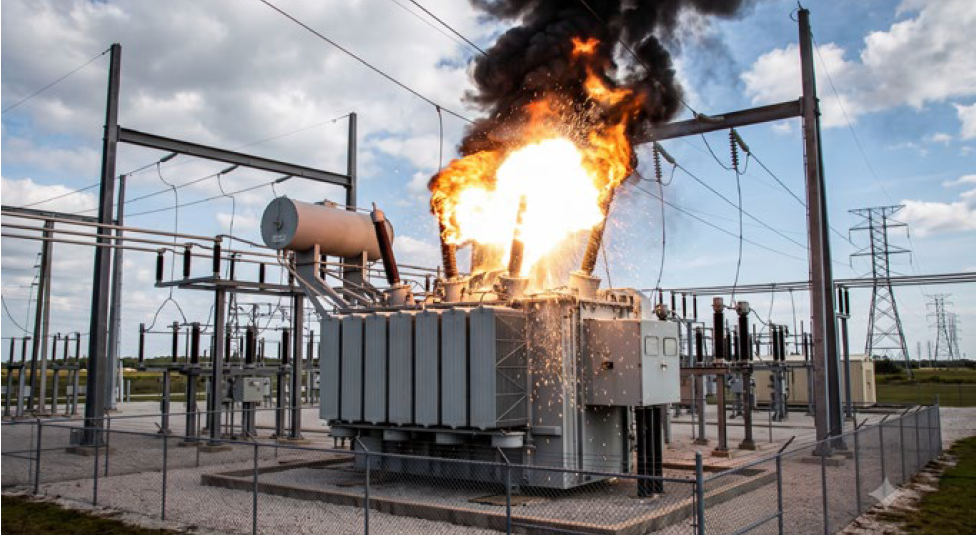
Rather than replacing the protection engineer’s judgment, these tools triage: surfacing the handful of events that genuinely warrant deep investigation out of thousands of routine ones, and pre-populating fault location estimates, affected zones, and likely root causes.
The more recent evolution — generative AI and large language models — adds another layer. These systems can synthesize natural-language summaries from raw oscillography and event logs, correlate disturbance data with maintenance records and asset history, and help less experienced engineers interpret complex multi-terminal fault scenarios by explaining relay logic and IEC 61850 logical node behavior in context. Combined with process bus architectures and time-synchronized sampled values, AI models can also detect subtle precursors to equipment failure that would be invisible in a single record but emerge across a time series.
The caution is that AI-assisted analysis is only as trustworthy as the data pipeline and the validation behind it. Misclassified events hallucinated causal narratives, or over-reliance on black-box outputs in a domain where mis-operations carry real safety and reliability consequences are real risks. The right framing is augmentation: AI narrows the search space and accelerates root-cause hypotheses, while the certified protection engineer retains final authority over the finding — much as it has always been with any new analytical tool introduced into this field.