(Reviewed by Alex Apostolov, USA)
As the global energy landscape shifts aggressively toward renewable sources, the fundamental physics of the power grid are changing. The displacement of synchronous machines by inverter-based resources (IBRs) strips the grid of its traditional inertia and fault current capabilities, rendering legacy control and protection schemes obsolete.
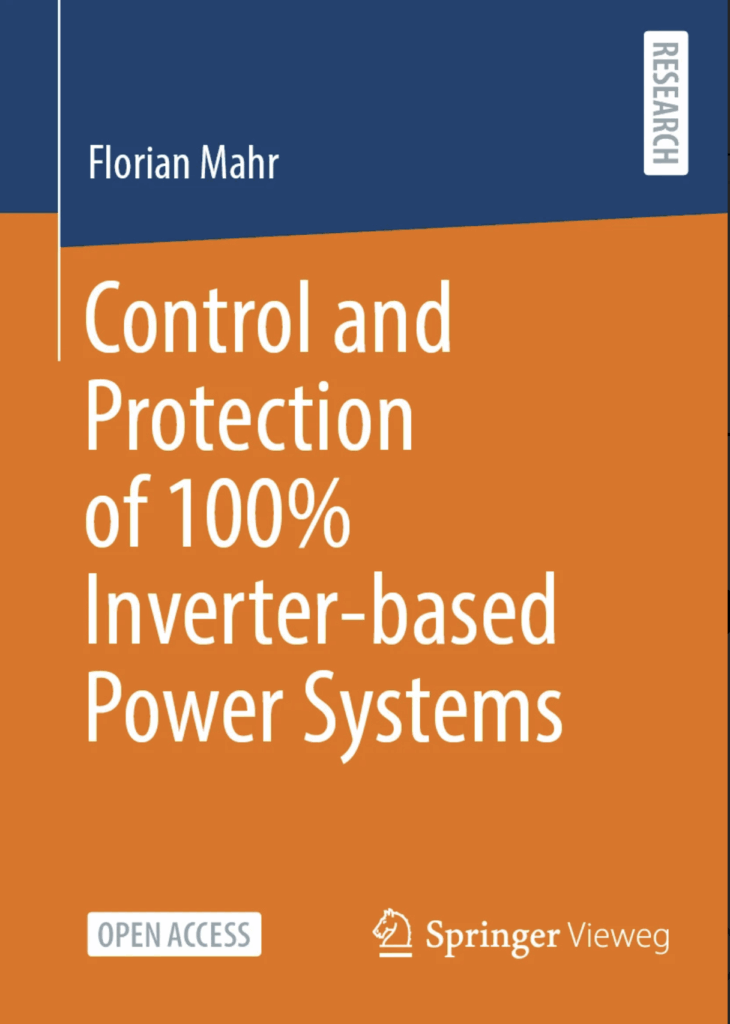
In this context, Florian Mahr’s Control and Protection of 100% Inverter-based Power Systems arrives as a timely and rigorous intervention. Mahr moves beyond the common “retrofit” mentality-trying to force inverters to act like old generators—and instead proposes a holistic redesign of grid architecture where control and protection are treated as a unified discipline.
The book is structured logically, guiding the reader from the fundamental physics of Voltage Source Converters (VSCs) to advanced system-level validation. It begins by establishing the necessity of Grid-Forming (GFM) controls, arguing that future grids cannot rely on phase-locked loops (PLLs) in weak network conditions. Mahr introduces sophisticated control strategies, utilizing state-space models and Linear-Quadratic Regulators (LQR) to achieve better dynamic performance over traditional cascaded PI controllers.
The core innovation of the text lies in its treatment of fault scenarios. Mahr introduces the “Resonant Grounding System (RGS) mode,” a novel concept where the VSC creates a virtual inductance in the zero sequence. This transforms the inverter from a passive participant into an active fault-suppression device capable of neutralizing single-phase-to-ground faults.
The final third of the book addresses the “protection gap.” Recognizing that VSCs cannot produce the massive fault currents required to trip standard fuses and relays, Mahr develops a Model-Based Protection (MBP) algorithm. This scheme uses Kalman Filters for dynamic state estimation, identifying faults by comparing real-time measurements against mathematical models rather than relying on simple current thresholds.
One of the book’s greatest strengths is its refusal to accept the limitations of VSCs as a liability. Mahr reframes the software-defined nature of inverters as an asset. The proposed RGS mode is an example of this; instead of lamenting the low fault current of VSCs, Mahr uses control logic to manipulate the zero-sequence impedance, achieving arc suppression that would be impossible with conventional machines. This is forward-thinking engineering that leverages the inherent flexibility of power electronics.
The rigorous methodology is another feature. The author does not rely solely on simulations. The inclusion of hardware laboratory tests using an analog grid model adds significant weight to the findings, proving that the theoretical models hold up under physical constraints.
However, the book is not without barriers. It is a dense, academic text rooted in a dissertation, and it presupposes a high level of literacy in modern control theory. Readers uncomfortable with state-space representation, Lyaponuv stability, or stochastic estimation (Kalman filters) may find the proposed solutions inaccessible. Furthermore, while the Model-Based Protection scheme is theoretically robust, the review could have benefited from a deeper discussion on the computational burden of running multiple parallel Kalman Filters in real-time grid controllers. The practicality of deploying such computationally heavy algorithms at the edge of the grid remains an open challenge that the industry must solve.
Additionally, the focus is strictly on the technical “how-to.” Readers looking for economic analysis, regulatory frameworks, or retrofitting strategies for existing infrastructure will find those topics outside the scope of this work.
This book is essential reading for researchers, PhD students, and advanced R&D engineers working in power systems and power electronics. It is particularly valuable for protection engineers who are struggling to adapt legacy schemes to renewable-heavy grids. It is less suitable for undergraduate students or utility operators looking for a general overview, as the content is highly specialized.
Control and Protection of 100% Inverter-based Power Systems successfully argues that the grid of the future cannot be built with the protection logic of the past. By synthesizing advanced control theory with grid protection, Florian Mahr provides a blueprint for a resilient, self-healing grid. While complex and mathematically demanding, the solutions presented here-particularly the RGS mode and Model-Based Protection-likely represent the standard operating procedures of the future. For those tasked with solving the technical paradoxes of the energy transition, this book is an invaluable resource.
Control and Protection of 100% Inverter-based Power Systems
Author: Florian Mahr
Publisher: Springer Vieweg (2025)
Softcover ISBN 978-3-658-47216-0
eBook ISBN 978-3-658-47217-7