Implementation, Testing and Validation at Tele-protection Santa Rosa-Carapongo 220 kV line in Peru
by Yony Machuca Huamaní, ISA ENERGÍA, Peru, Francisco Gonzalez-Longatt, Loughborough University, UK,
Juan Velarde Tinoco, SIEMENS, Peru, and Joao Marcio Jorge, OMICRON electroncs, Brazil
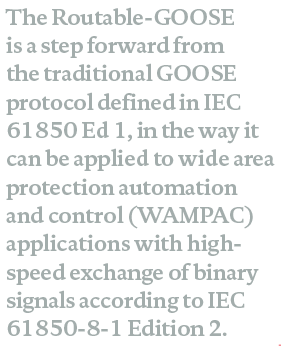
The Routable-GOOSE, also known as R-GOOSE, is a step forward to the from the traditional GOOSE protocol defined in IEC 61850 Ed 1, in the way it can be applied to wide area protection automation and control (WAMPAC) applications with high-speed exchange of binary signals according to IEC 61850-8-1 Edition 2.1, including the Technical Report IEC 61850-90-5; so, in this sense, the R-GOOSE can go outside the substation LAN. The R-GOOSE is a Layer 3 message based on UDP (User Datagram Protocol) /IP, unblocked by the Router.

This article presents the results of a real-life implementation, testing, and validation of Routable GOOSE in the tele-protection system for the overhead transmission line Santa Rosa-Carapongo 220 kV in Peru. This is the first implementation of the R-GOOSE in South America. This article compares this new approach with the previous tele-protection media used via power line carrier (PLC).
The well-known IEC 61850 has been identified as one of the major Standards applied in developing and consolidating the so-called smarter grids. An essential element of this intelligence enabler is the Generic Object-Oriented Substation Event (GOOSE) message, which supports peer-to-peer communications between multi-functional intelligent electronic devices (IEDs) that meet the high-speed performance requirements of protection and automation and control (PAC) applications. The classic GOOSE is a fast, repeated signal from one Publisher to anyone who wants to be informed via multicast messages. However, the traditional GOOSE was initially designed as a non-routable message that is confined to the power substation over the local area network (LAN), limiting its applicability for wide-area protection, automation, and control (WAPAC) applications.
The so-called Routable GOOSE (R-GOOSE) is a variant of the traditional GOOSE [6]. The R-GOOSE communication leverages the advantages of the conventional GOOSE. Still, it can be applied to WAMPAC applications that transmit binary signals at high speed, as specified in IEC 61850-8-1 Edition 2.1, including Technical Report IEC 61850-90-5. Therefore, in this sense, the R-GOOSE can extend beyond the substation LAN. The R-GOOSE is a Layer 3 message based on UDP (User Datagram Protocol)/IP, unblocked by the Router.
One potential application that benefits the R-GOOSE is inter-substation trip and scheme communications. The traditional overhead transmission line is protected by a line impedance protection function that utilises the OPGW link inside the transmission line; however, the R-GOOSE has the potential to enhance the performance and reliability of this approach. To date, half of the four leading IED original equipment manufacturers (OEMs) offer the R-GOOSE functionality.
This paper presents the results of a real-life implementation, testing, and validation of Routable GOOSE in the context of the Tele-protection system for the overhead transmission line Santa Rosa-Carapongo 220 kV in Peru. Section 2 provides the specific background and elements necessary to understand the test used in this paper. Experimental setup and results are then presented in Section 3, followed by the article’s conclusions.
1. Background
This section shows the main background elements required for this scientific article.
1.1 Understanding the GOOSE and R-GOOSE: GOOSE, or Generic Object-Oriented Substation Event, is a high-speed, event-driven communication protocol defined in the IEC 61850 standard and is essential for modern digital substations. The traditional GOOSE is designed to enable peer-to-peer communication between intelligent electronic devices (IEDs) in a substation, and it is typically used for circuit breaker tripping, interlocking schemes, fault location, busbar protection, etc. However, the traditional GOOSE is a messaging protocol at layer 2 of the Ethernet, utilising MAC multicast for specific applications in substations.
The R-GOOSE is an extension of the traditional GOOSE messaging defined in the IEC61850 Edition 1, and it is enabled with several characteristics that allow it to be used beyond the conventional scope of the local substation local area network (LAN) and using an IP-based communication. A comparison between the traditional GOOSE and R-GOOSE is presented in Table 1. IEC 61850 Edition 2 Amendment 1 marks a pivotal evolution in substation and wide-area communication by formally introducing R-GOOSE and R-SV—routable versions of GOOSE and Sampled Values designed for secure, IP-based transmission across wide-area networks (WANs).
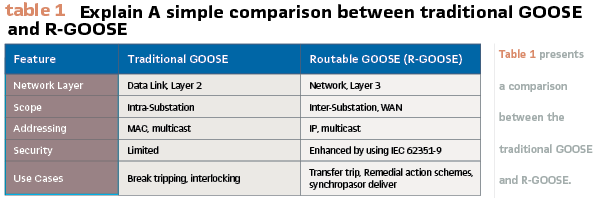
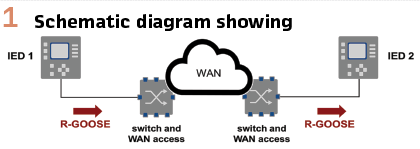
Figure 1 illustrates IED1 sending R-GOOSE over a WAN to IED2. The figure also depicts the switch and WAN Access, enabling R-GOOSE messaging. As the R-GOOSE operates over IP/UDP multicast, it requires devices with Layer 3 routing capability to forward packets across subnets or WAN segments.
Because the R-GOOSE message is designed for inter-substation communication, the packets must traverse the WAN. Some implementations utilize a dedicated utility WAN, but other options include using a secure VPN tunnel or SONET (Synchronous Optical Network) / SDH (Synchronous Digital Hierarchy) infrastructure in legacy systems.
When deploying the R-GOOSE, there are two main options: (i) an IED with native R-GOOSE support, in which case the IED can publish the R-GOOSE over IP. This option may require upgrading or refurbishing some of the existing IEDs, but a simple firmware update is a realistic option in the modern IEDs. (ii) Gateway-based conversion: The traditional substation gateway subscribes to the traditional Layer 2 GOOSE, and the gateway republishes the message as an R-GOOSE over the WAN.
MPLS-TP, or Multiprotocol Label Switching Transport Profile, is a specialised version of MPLS designed for transport networks, offering greater predictability and manageability compared to standard MPLS. It is designed to meet the specific requirements of transport networks, particularly those transitioning from older technologies such as SDH/SONET.
MPLS-TP is a deterministic, connection-oriented Layer 2.5 transport technology that can work well with R-GOOSE. This layer 2.5 transport offers several advantages, like low latency and jitter, making it quite attractive for time-critical protection signals.
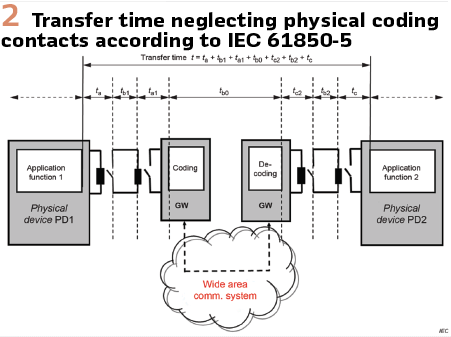
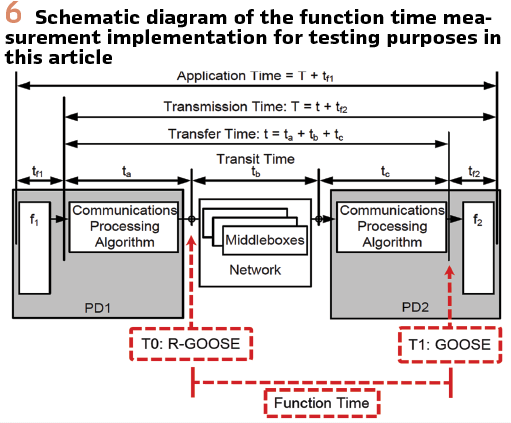
1.2 Transfer Time Assessment: A detailed model for evaluating the total transfer time (t) of binary signals within line protection schemes, particularly relevant in teleprotection applications based on R-GOOSE, is presented in IEC 61850 (see Figure 2). The transfer time is defined as the sum of three fundamental components: the encoding time at the transmitting IED (ta), the transmission delay across the communication network (tb), and the decoding time at the receiving IED (tc).
For critical signals such as remote trip commands, the standard defines stringent performance classes-such as TT6 (≤ 3 ms) and TT5 (≤ 10 ms)-which must be met even across inter-substation links. In the context of R-GOOSE, this model reinforces the need to design communication networks with low latency, controlled jitter, and high availability. In R-GOOSE applications, compliance with TT5 and TT6 classes is crucial to ensure that trip and block signals are transmitted within the required time margins, even across WAN infrastructure.
2. End-to-End Test to Assess R-GOOSE Protocol
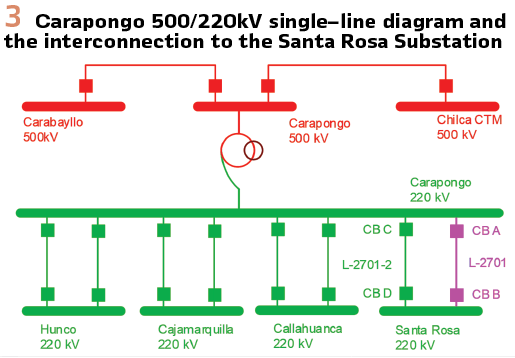
2.1 System Description: This article proposes an end-to-end field test to validate the performance of the R-GOOSE protocol over an MPLS-TP network, compared with the conventional PLC system used in the teleprotection scheme of the 220 kV Santa Rosa–Carapongo transmission line (see Figure 3, specifically transmission line L-2701.)
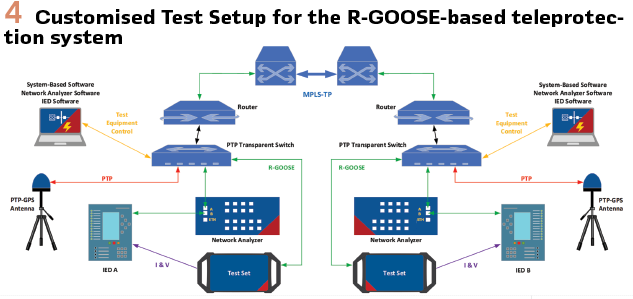
The protection system for this line consists of IEDs protection relays installed at both terminals, supported by two redundant teleprotection communication channels. These channels enable the implementation of the following protection schemes: permissive overreach transfer trip (POTT), directional comparison overcurrent (67NCD), and direct transfer trip (DTT). The primary communication channel utilises power line carrier (PLC) technology with equipment installed at both ends of the line. The redundant channel employs teleprotection devices connected to a fiber-optic link via multiplexers. The transmission and reception of teleprotection commands from the redundant relays to the communication equipment are carried out via hardwired connections, ensuring reliable, synchronised operation of the protection schemes. The tools used for configuring the protection relays and implementing the R-GOOSE protocol were engineering software and IEC 61850 System Configurator, respectively. These platforms enable advanced parameterisation of protection devices and the definition of communication services in compliance with IEC 61850 (see Figure 4).
The R-GOOSE communication link was deployed over a Virtual Private Network (VPN), configured using IPSec (Internet Protocol Security) encapsulated within GRE (Generic Routing Encapsulation). This architecture supports the transport of IP packets, including IPv6 and multicast traffic, via GRE tunnels over IPv4 networks. Specifically, the Encapsulating Security Payload (ESP) protocol was implemented to securely encapsulate R-GOOSE packets, ensuring reliable and protected communication between the protection system endpoints.
The software-based system models the power system under test, incorporating the characteristics of the primary transmission line and its parallel counterpart, system equivalents at both terminals, current transformers, and the station bus utilizing R-GOOSE messaging. This modelling framework enables the evaluation of various fault scenarios spanning 5% to 95% of the line length, with fault impedances (Zf) of 0 and 10 ohms.
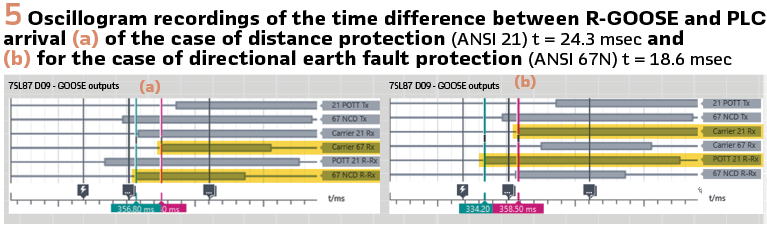
2.2 Results: For the case of a single-phase fault on phase A at 95% of the transmission line length, with a fault resistance of 10 ohms, Figure 5a shows that the POTT teleprotection scheme based on R-GOOSE achieves a reception at the Carapongo terminal 24.3 ms faster than the carrier-based system, resulting in a shorter fault-clearing time. Similarly, Figure5b demonstrates that the Directional Earth Fault protection (ANSI 67NCD) scheme using R-GOOSE also outperforms the carrier-based system, with an 18.6 ms advantage in reception time.
For this study, an alternative methodology was adopted in place of the conventional approach based on the internal event logs of Intelligent Electronic Devices (IEDs), which are typically used for measuring transfer time. Instead, R-GOOSE messaging was used to define the T0 instant (signal transmission start), while conventional GOOSE messaging was configured to mark the T1 instant (signal reception) via specific settings within the IEDs. Furthermore, a software-based testing system was employed to measure the composite time consisting of network latency and processing time (Network Time + tc), referred to as the Function Time. Figure6 illustrates the methodology used for Function Time measurement.
The implemented methodology enabled automated acquisition of Function Times for various single-phase and three-phase fault scenarios spanning 5% to 95% of the transmission line length, with fault impedances of 0 and 10 ohms.
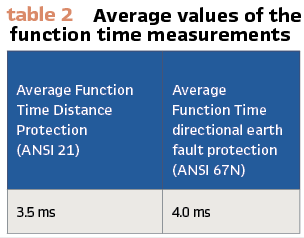
The average Function Time measured across the various fault scenarios was 3.5 ms for the POTT function distance protection (ANSI 21) and 4.0 ms for the directional earth fault protection (ANSI 67NCD), as summarized in Table 2. These values support the evaluation of compliance with the P2 performance class and the TT5 transfer time requirement, as defined in IEC 61850-5.
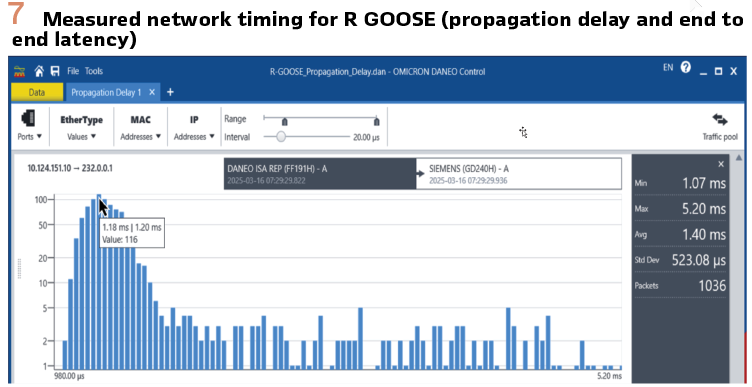
Critical performance parameters for the transmission of RGOOSE messages, intended for high-speed protection applications in power systems, were evaluated. Metrics such as average network transit time, propagation delay, and end-to-end latency were analyzed using network analyzers synchronized via the Precision Time Protocol (PTP), achieving 100 ns timing accuracy. Data capture was performed in TAP mode, with specific filters to isolate R GOOSE frames, thereby ensuring the integrity of the analysis. Figure 7 presents the results obtained over a 22.3 km infrastructure incorporating MPLS TP technology, revealing an average network transit time of 1.40 ms and a jitter of 4.13 ms-values considered suitable for demanding protection schemes.
2.2.1 Transfer Time Calculation: The transfer time is calculated as shown in the following equation:
Transfer Time (t) = Processing Time (ta)+ Transfer Time (tb) + Processing Time (tc)
Function Time (t) = Network Time (tb)+ Processing Time (tc)
Taking the average function times from Table 2 together with the average network transit time, the average processing time t_c for the right-hand IED, it can be calculated as:
Average tc = (Function Time_avg ) – (Network Time_avg)
Average tc (ANSI 21) = (3.5ms) – (1.4ms) = 2.1ms
Average tc (ANSI 67N) = (4.0) – (1.4ms) = 2.6ms
Assuming tc = ta (identical IED model, hardware, and firmware):
Transfer Time (t)
= Processing Time (tc) + Transfer Time (tb )+ Processing Time (tc)
Average tANSI 21 = (2.1ms) + (1.4ms) + (2.1ms) = 5.6ms
Average tANSI 67N = (2.6ms) + (1.4ms) + (2.6ms) = 6.6ms
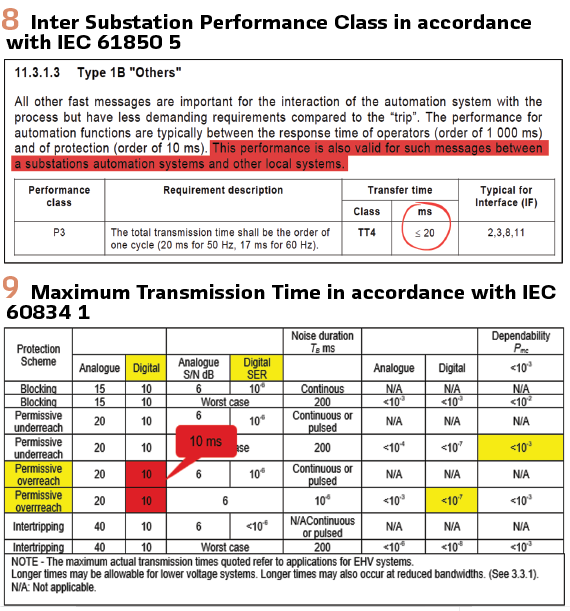
Finally, the total transfer time, computed from the IED processing time, the function execution time, and the network latency, complies with performance class P2 and the TT5 transfer time requirement (≤ 10 ms) specified in IEC 61850 5. Furthermore, the same standard states that the maximum class TT4 (maximum transfer time ≤ 20 ms) applies to inter-substation messages; therefore, the measured transfer time is within specifications.
In addition, the results obtained are within the acceptable limits for permissive overreach transfer trip (POTT) schemes, in accordance with IEC 60834 1, as shown in Figure 9.

3. Conclusions: This article presents the first implementation of R-GOOSE in South America and presents testing and validation results that clearly demonstrate the latency of R-GOOSE against PLC justifies its implementation, along with the safety and reliability added by R-GOOSE over PLC (ISA REP in the past had maloperations via PLC). The “average” approach used to determine the performance of the real R-GOOSE/MPLS-TP system in Peru is considered correct once we can perform network measurements and estimate average performance across different automated test scenarios. IEC 61850 does not specify communication performance requirements and classes for permissive teleprotection schemes; however, IEC 60834-1 defines these requirements, and the measurements and calculations in this paper validate the WAM telecommunication system under study.
Biographies:
Yony Machuca Huamani is an Electrical Engineer, graduated from the National University of Central Peru (UNCP), with over a decade of experience in the operation and maintenance of high-voltage electrical substations. He is currently pursuing postgraduate studies in Power Systems at the National University of Engineering (UNI). Presently, he holds the position of Specialist in Protection and Control Maintenance at ISA ENERGÍA PERU.
Francisco M. Gonzalez-Longatt is Founder and leader of the DIgEnSys-Lab (Digital Energy Systems Laboratory) at the Department of Electrical Engineering, Information Technology and Cybernetics, University of South-Eastern Norway, Norway; He is currently with the Centre for Renewable Energy Systems Technology (CREST) at Loughborough, University in the United Kingdom. His main area of interest is empowering the secure and resilient operation of energy systems by taking advantage of the digital technologies.
Joao Juan Velarde Tinoco graduated as an Electrical Engineer from the National University of Engineering in Peru, specializing in substation protection and automation. He began his career at Siemens Peru as a commissioning engineer, contributing to major transmission projects in Peru, Venezuela, and Chile. During 2017–2018 he served as lead test engineer in 500 kV substations, overseeing critical energization and commissioning tasks. In 2019 he became a Portfolio Consulting Professional, supporting strategic utilities and advancing solutions including SIPROTEC 5 and SIPROTEC Digital Twin. He currently works as a Customer Solution Architect, developing advanced protection and automation architectures for utilities.
Joao Marcio Jorge is an Electrical Engineer, specialist in Power Systems Protection, Control, Communication, Automation & Testing Solutions, acting as IEC 61850 Regional Application Specialist for OMICRON Electronics Latinoamerica; has a postgraduate degree in Electrical Systems Protection and is pursuing a postgraduate degree on Cyber Security. Active member of Cigre Brazil Study Committee B5.