By Rene Troost, Amadou Louh and Joey Goderfrooi, Stedin, The Netherlands, Andrej Goerbing, Vincenzo Fiorentino, Philipp Staschel and Volker Gsaenger, Siemens, Germany, Sebastiaan van Kuk, Alliander Telecom, The Netherlands
5G is the first generation of mobile communication which natively considers the use cases and requirements of commercial customers in various domains (the so-called “verticals”), where electric power distribution is one among many others. One of the important improvements compared to previous mobile network generations is the support of real time communication with low latency and packet loss, high reliability, availability and security. 5G provides various options for deploying private mobile networks, with physical or virtual separation from public 5G communication. Based on these capabilities, the wireless 5G technology appears to be an excellent candidate to cover the business needs of distribution system operators (DSOs), as an alternative to a costly underground fiber optical infrastructure to a huge number of small substations with currently no communication.
Alliander, Siemens and Stedin cooperated on executing a joint 5G pilot test at Stedin facilities in Delft, The Netherlands from November 2024 till March 2025. The focus was on running line differential protection communication of relays via an Industrial 5G system. Line differential protection has been selected for the pilot because it is becoming increasingly relevant in power distribution and due to its high requirements for network communication.
For a Distribution System Operator (DSO) such as Alliander and Stedin, 5G is of interest as it supports further grid digitalization and enables real-time monitoring and control. It offers a technological pathway towards future time critical applications, while maintaining control over availability and security through private network deployments. In addition, 5G can become increasingly relevant as part of a futureproof telecom landscape that complements existing communication technologies rather than replacing them.
The purpose of the pilot test is investigating the current state of 5G technology and its applicability for protection communication in the power distribution grid. All participants are aware that the 5G technology is not mature yet regarding the promised real time capabilities. Chipsets and network equipment supporting 5G URLLC (Ultra Reliable Low-Latency Communication) are still not commercial available on the market. Nevertheless, the participants were interested in getting practical experience with 5G communication for a significant and demanding application.
The pilot test is the continuation of previous 5G related activities of a supplier and Stedin, which have started with the preparation of a joint paper (together with a standardization expert of Huawei) presented at CIGRE session in 2022.
Line Differential Protection Communication via 5G
Protection of power systems ensures the safe and reliable operation of electrical networks. It involves detecting faults and isolating affected sections to prevent damage and maintain stability. Overcurrent protection prevents damage from excessive currents caused by short circuits or overloads, using devices such as fuses, protection devices and circuit breakers to interrupt the current flow. Effective protection strategies are crucial for minimizing downtime and ensuring the safety of personnel and infrastructure.
Grid operators use different protection principles. The most fundamental is overcurrent protection, requiring current inputs at a specific point. This method can be enhanced by incorporating voltage measurements to enable directional elements. More advanced single-sided solutions include distance protection relays, which operate based on impedance measurements.
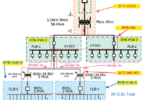
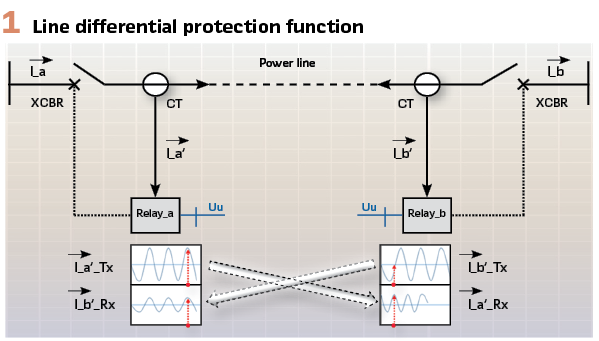
The differential protection function is working on the current difference between two terminal currents. The line current differential protection (defined as 87L in IEEE C37.2-2008) scheme is depicted in Figure 1 and is based on the principle of comparing the amplitude and the phase of the local terminal currents (e.g. Relay_a in Figure 1) and the remote terminal currents (e.g. Relay_b in Figure 1), on both sides of the protected object.
Figure 1 shows two communication channels (illustrated as dashed arrow boxes) between the two protection relays used for transferring the current phasors (or Sampled Values) measured on both line ends. For Relay_a, at a given moment the local current is I_a’_Tx, and the time-aligned remote current from Relay_b is I_b’_Rx. Using them as input, the protection algorithm in Relay_a derives the differential current. The current phasors from the two protection relays, deployed geographically apart from each other, should be aligned in time for the current differential algorithm to execute correctly. The same mechanism is applied in Relay_b. This time alignment is typically done using an external synchronization signal (1PPS, PTP or GNSS). Time alignment methods based on measuring the channel round-trip time cannot be applied for 5G systems.
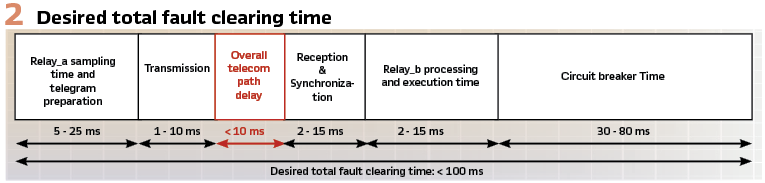
The desired total fault clearing time is below 100 ms. Considering the processing and forwarding delays in the sending and receiving relay, and the circuit breaker time, the network communication delay should be below 10 ms (see also Figure 2).
Due to the continuous calculation of (fault) currents, there are relatively high requirements for line differential protection communication in terms of time synchronization, latencies and reliability. These requirements are described in 3GPP Rel.16 TR 22.804, 5.6.6 and 3GPP Rel.18 TR 22.867, 5.4.1. and could be challenging for mobile networks. The requirements for line differential protection using Ethernet-based communication channels are:
- Continuous communication between protection relays attached to the 5G network, which is based on IP unicast and multicast, with up to approx. 2 Mbit/s in uplink and downlink direction
- Maximum end-to-end communication latency 5 ms to 10 ms with latency asymmetry < 2 ms
- High reliable communication with minimum corrupted and dropped packets (typical < 1 %)
- High available communication (service availability at least 99,95% according to IEC 60870-4, class A3) with minimum recovery time. Depending on the utility’s back-up protection scheme
- The 5G communication shall not be interrupted or disturbed in case of power grid failure (power supply outage) in the served area
- High precision and reliable time synchronization of protection relays
Why Line differential protection using 5G communications? The changes in the energy landscape with an increased penetration of Renewable Energy Resources (RES) consisting of a high amount of Inverter Based Resources (IBR) introduced new challenges. In short, some protection principles used for decades are facing serious issues. This is clearly depicted in the CIGRE 2024 tutorial and evaluated in the PAC World magazine article.
Line differential protection (unit protection principle) is considered a reliable and future-proof protection concept, also within the challenges in the energy landscape. The downside is the need for a communication channel between all relays at all line ends. Traditionally, utilities use pilot wires or dark fibers for the communication part. Nowadays, IP networks are utilized as well. The need for physical networks is costly and forces utilities to investigate alternative solutions. The technological advancements of 5G communication are a serious opportunity for this use case.
5G is specifically designed to support ultra-reliable, low latency communication (URLLC), which is a fundamental requirement for exchanging protection data between substations. Through capabilities such as URLLC, a private 5G Stand Alone (SA) network offers a controlled environment to evaluate whether wireless communication can meet the stringent performance, availability, and security requirements of protection schemes. The 5G SA network guarantees the highest level possible of data security and reliability as it operates in private spectrum allocated to the DSO and all data remain within the DSO network.
High precise and reliable synchronization is the precondition for comparability of current phasors measured by the protection relays at the line ends. In packet-based networks such synchronization is typically applied by help of the Precision Time Protocol (PTP). In case of line differential protection in power distribution networks using 5G communication it is advantageous to provide the PTP synchronization via the mobile network to the locations of the protection relays. 3GPP standardisation specifies the use of a small, explicit set of PTP profiles but current 5G network deployments predominantely do not support this synchronization capability so far.
Even if full URLLC functionality and PTP synchronization is not yet available, a pilot remains valuable to assess how 5G performs without these features, to understand baseline latency, stability, and failure behavior under realistic grid conditions. This allows gaining practical experience, identifying limitations, and evaluating future potential, while keeping the scope exploration and complementary to existing, proven protection communication technologies.
5G Private Spectrum & Regulation and the Industrial 5G System
The introduction of private 5G SA networks is supported by private spectrum allocation. Germany was the pioneer in this area as it allocated 100 MHz already in 2019 for the deployment of private campus networks. Several European countries, Brazil, US, Canada and others have allocated private spectrum in the n78 and n77 band, 3300MHz-4200MHz, enabling the spread of private 5G for the industry. The regulation can be different in different countries, for example in Germany the licenses are limited to the area of the property or like in the US there is no strong geographical limitation because the spectrum is managed in a different way.
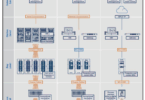
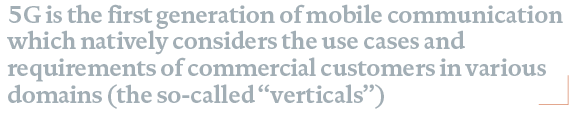
The supplier’s end-to-end system is composed of the following elements: a core, a radio access network (RAN) and the user equipment (UE). (Figure 3).
The Core SW runs on an industrial PC that includes management software for the system configuration and operation. A Web UI allows the user to configure IP addresses, radio parameters, frequency band and maximum transmitting power, SIM provisioning and security keys. The Web UI offers also a dashboard for the monitoring of the main KPIs, like throughput, number of UE connected, the status of each device and logs in case of problems. A set of virtual functions according to 3GPP specifications are implemented in the core to set up connectivity between the core user plane and the UE.
The RAN is designed according to the Open RAN (O-RAN) Alliance definition that indicates how the RAN can be disaggregated to have a more flexible and performance optimized deployment. The RAN is made of a Central Unit (CU) and Distributed Unit (DU) and a Radio Unit (RU). The first two manage all needed radio functions to enable access and authentication of the UE, mobility management and set up of appropriate radio bearers. In the adopted O-RAN split option, 7.2, the upper physical layer (PHY) is included in the DU while the lower PHY is in the RU. The lower PHY includes the base band processing and the RF parts.
The 5G infrastructure release used during the pilot test was the first commercial product version. It supported only best effort traffic and operated in the frequency band from 3600 – 3800 MHz, with bandwidth 40, 80 and 100 MHz. The initial limitation of quality of service (QoS) prioritization did not have any impact because the network was not loaded with other applications. The performance of the technology was evaluated, and it was confirmed that it has the potential to be used for protection schemes.
In conclusion, the 5G system used for the tests is a basic solution with the scope to provide best effort connectivity. With the availability of the new versions more advanced features like quality of service, traffic prioritization, redundancy and lower latency could be verified in the future.
Communication Test Setup of the 5G Pilot
The test setup network topology is depicted in Figure 4. The test equipment was placed in two buildings, establishing two test networks, named “primary substation” and “secondary substation,” which were connected by 5G communication.
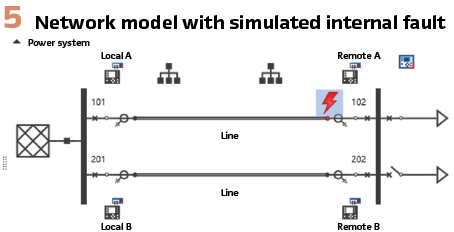
The Industrial 5G system has been deployed in the “primary substation”. It consists of two Industrial PCs (IPCs) running the 5G Core Network (CN) and the 5G Radio Access Network (RAN) software, the Radio Unit (RU) plus 5G antenna, an IP router and a firewall device. The Dutch regulatory body assigned an experimental license/permit in the frequency range of 3750 – 3800 MHz. The 5G system used the frequency range of 3760-3800 MHz.
There are three-line differential protection relays PR1.1 … PR1.3 in the “primary substation” which are connected via the Ethernet switch SW1.1 to the firewall of the 5G system. The switch deploys a GPS receiver and serves as GPS-controlled IEEE 1588 PTP Grandmaster Clock for synchronizing the protection relays in the “primary substation.”
The setup in the “secondary substation” consists of three-line differential protection relays PR2.1 … PR2.3, the Ethernet switch SW2.1 and the 5G mobile router MR2.1 with 5G antenna. The switch is in the role of GPS-controlled PTP Grandmaster Clock for the protection relays in the “secondary substation.”
The line differential protection relays require high accurate global time synchronization, but this is currently not provided by the 5G system. The PTP Grandmaster Clocks are therefore deployed in Ethernet switches in the “substations.” The 5G radio link is established between the 5G mobile router in the “secondary substation” and the 5G radio unit in the “primary substation.” The distance between the 5G antennas is approximately 200 meters.
In the pilot setup it has been chosen to run the protection communication on OSI Layer 2 / Ethernet via the 5G network. Since 5G basically supports Layer 3 / IP data communication, the 5G system provides a virtual LAN service (VXLAN) for Layer 2 communication.
There is one relay tester per “substation.” These devices communicate with each other via the 5G network. For this purpose, the testers are connected to the Ethernet switch of their “substation.”
The testers are PTP synchronized from the switch they are connected to.
Executed Tests and Their Results
Test Setup: To measure the individual channel delays two synchronized test devices were used. The parallel line arrangement, which is typical for MV and HV applications at Stedin, was modelled in the testing software to measure the operating time delay and channel delays. (Figure 5).
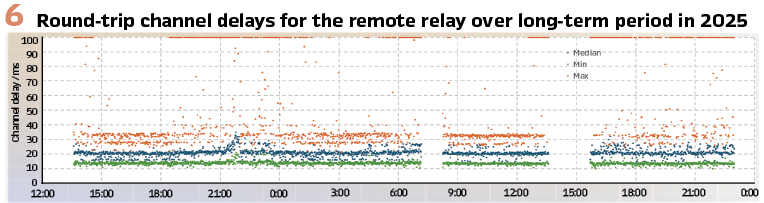
Long-term Channel Availability Test: The long-term channel availability was tested using a simple ping-test. Every two seconds a ping was sent to both IED’s (local and remote). Tests have been executed at different days. While to local relay ping tests resulted in less than 2 ms, the remote ping delays are the round-trip times (RTT) and are shown in Figure 6.
In Figure 6 the median, minimum and maximum measured channel delays are plotted for each minute for more than 24 hours. The maximum values are clipped to 100 ms in the figure (for better visibility). These values represent times of degraded channel availability. It is assumed that interferences occurred during these test times. Median values of 21 ms and minimum delays of 14 ms have been measured for RTT during these tests.
Tests Regarding the Channel Delay: The individual channel delays (A->B) and (B->A) have been measured using a binary signal exchange between both relays A and B. The test device at the remote end (B) triggered a send pulse. This signal is transferred to local relay (A) and returned to B. B then sends the signal to A again. The sequence is: B ->A ->B-> A .
The absolute times of signals arriving at the local relay (A) and remote relay (B) is the channel delay “A->B”. The return delay is “B ->A”.
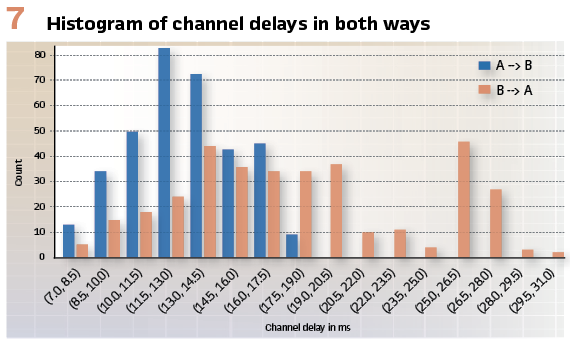
In Figure 7 both channel delays of 350 tests are plotted as a histogram. Channel A->B has lower delays (10 ms to 17 ms) than the return channel (12 ms to 28 ms.) While the A->B measurements follow a normal distribution, the return path delays follow a multimodal distribution with two peaks. One reason for two peaks is that the test data consists of three different execution times over one day and possible radio interferences.
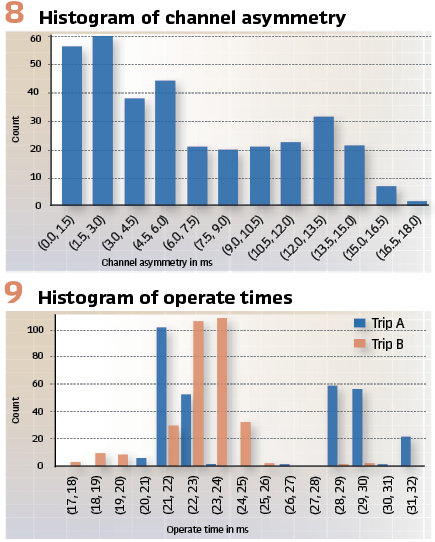
The absolute channel asymmetry is provided in Figure 8. Up to 18 ms asymmetry was measured during these tests. Such asymmetry does not affect the application of line differential protection, because external synchronization based on PTP is used.
The asymmetry is due to a particular uplink scheduling in the 5G radio protocol, and this is an example of the area of improvement that URLLC can bring into the system.
Operate Time Tests: Three phase faults have been simulated at the line end 102 with fault resistance of R_f=1 Ω to measure the fastest operation times of the relays using 5G communication (see also Figure 5). The parallel line was disconnected (single line arrangement).
A variation of fault parameters (e.g. fault type, location, resistance, short circuit power) was not performed in this project. These results were already obtained when testing Line Differential protection over IP/Ethernet networks in a previous project at Stedin. The application principle in both projects was the same – current phasors are time synchronized by PTP – and therefore no differences with respect to accuracy, dependability or sensitivity were expected.
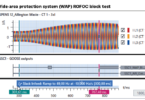
The operating time of local (A) and remote relay (B) were measured and shown in Figure 9.
Typical operating times are in the range from 17 ms to 30 ms. Considering the initial requirements in chapter 2 with circuit breaker times of 30 ms to 80 ms, this can still be sufficient for the application.
Conclusions and Recommendations: For Distribution System Operators, protection functions are safety critical and directly linked to public reliability obligations. Consequently, any use of 5G for protection purposes should be regarded as complementary and exploratory, rather than as a replacement for proven wired protection channels. Wireless protection communication may nevertheless become relevant in specific scenarios, such as rapid grid expansion, temporary network configurations, or locations where fiber deployment is time consuming or economically challenging. From a DSO perspective, 5G should therefore be assessed as part of a layered and diversified telecom portfolio that enhances overall system resilience instead of introducing dependency on a single technology. The results of this pilot test further demonstrate that individual DSOs have limited influence on the maturity and availability of advanced 5G features, underlining the importance of cross DSO collaboration and joint engagement with vendors and standardization bodies.
While the simplicity of line differential protection as a principle is appealing, it imposes complex telecommunications requirements. The current implementation showed that 5G can theoretically meet these demands, but the deployed technology is not ready to fulfil the expectations. In particular, there are some missing 5G-specific features, such as Ultra-Reliable Low-Latency Communication (URLLC). The primary moneymaker in 5G developments seems to be consumer electronics, since URLLC enabled hardware and software are still commercially not available. This suggests that utilities should advocate collectively to influence future 5G feature releases.
Interference between 5G New Radio (NR) networks, especially in areas with parcel-bound frequency allocations, where frequencies are assigned to specific geographic parcels, should be properly regulated. This exacerbates in densely populated or industrial zones, highlighting the need for coordinated spectrum management and synchronization across networks. Some applications, like local substation coverage could be affected by potential interference generated by neighbors. Other applications like primary to secondary substation point-to-point communication require a regional licensed spectrum allocation.
As initially anticipated, the current 5G network hardware and software are not yet mature enough to fully support the primary use case of line differential protection. However, the conducted test demonstrated that this use case is likely to be feasible in the future with next-generation hardware and software. The 5G system version used in the test was the first commercial release, which offered only limited features. Despite its basic capabilities, the system showed that line differential protection over a private 5G infrastructure is achievable with relatively good performance at times without spectrum interferences. Nevertheless, several improvements are necessary to reach a commercially viable solution for such applications as support for latency-critical communication, 5G node and communication redundancy and enhanced resilience to unexpected interference.
While the transport of the PTP signal over 5G is also a requirement, the priorities are on the improvements listed above.
A future 5G pilot test should focus on conditions that more closely reflect real-world deployment scenarios, including extended radio link distances and increased number of concurrent protection communication streams.
Next, to validate performance future pilots should also aim to build operational understanding of failure modes, manageability, and integration with existing OT processes.
Biograpies:
Rene Troost works as a Grid Strategist at Stedin, where he is responsible for Substation Automation policy and provides strategic direction within the grid control domain. Beyond Stedin, he actively participates in and leads national initiatives. As Dutch CIGRE B5 representative, he represents the Netherlands internationally. René is an active member of IEC TC57 working groups 10, 17, and 19, a CIGRE Distinguished Member, and serves on the Advisory Board of PAC World and the Board of Directors of the UCA International UG.
Amadou Louh is a strategic advisor for OT infrastructure and telecommunications at Stedin, focusing on OT communication and hosting platforms. He holds two MSc degrees in Telecommunication and Power Systems (High Voltage Engineering) from Delft University of Technology. His work has focused on defining OT platform strategies, datacenter policy and architecture for OT environments, and translating grid level functional requirements into standardized telecom and OT platform services to support long term, future proof operations.
Joey Godefrooi is a senior protection engineer at Stedin with over 20 years of experience in protection systems, substation automation, and OT cybersecurity for critical energy infrastructure. His work focuses on the design and secure deployment of advanced protection and automation concepts, including line-differential protection communication technologies. He combines a hands-on engineering approach with strong expertise in translating complex technical and security challenges into reliable, operational solutions for the power grid.
Andrej Goerbing is a System Architect Communication at product development of Siemens Smart Infrastructure / Electrification & Automation in Berlin / Germany. He is involved in the development of Siemens SIPROTEC protection relay communication and IEC TC57 WG10 standardization, regarding power utility substation-internal and wide area communication and IEEE 1588 PTP synchronization. Andrej has over 30 years of experience in development and practice of various wireline and wireless communication technologies.
Vincenzo Fiorentino is Portfolio Owner Blueprints and Systems for Industrial Communication at Siemens AG in Nuremberg, Germany. His responsibility covers the private 5G infrastructure applied to the industry with special focus on critical infrastructure, railways, electric power and system management. He has 31 years of experience in the wireless industry. He has started as Research Scientist in the UK, working on the investigation of advanced radio interfaces for wireless LAN and 3G technologies. Later moved to Italy as Senior Consultant for UMTS where he contributed to the start-up of the first 3G network in Europe, first in the radio planning and later moved to the International Services and Roaming department. In 2011 Vincenzo moved to Germany to work as a Product Manager providing testing services to telecom operators worldwide. In 2019 he changed to Siemens AG and uses his broad wireless technology knowledge for the development of 5G for the industry.
Philipp Stachel studied electrical engineering at the Technical University of Dresden, followed by a doctorate (2011) in the field of power system protection. From 2012 to 2022, he was an application expert and R&D engineer, responsible for line protection topics at different relay manufacturers. Since 2022, Philipp joined Siemens as a product lifecycle manager for line differential protection. Member of IEC TC95, DKE K434, CIGRE SC B5.
Volker Gsaenger received his Dipl.-Ing. (FH) in Electrical Engineering specialized in Automation Engineering at the Georg-Simon-Ohm University of Applied Sciences in Nuremberg. In 1994 he started his career with Siemens and was involved in the development of Engineering Software for several Protection and Substation Automation systems. Since 2016 he has been Consultant for Industrial Communication at Siemens with focus on Electric Power Industry. He is also active member of IEC TC57 WG10 and active member of IEC TC65 / SC65C / WG15 in which he is editor of IEC 62439-3 ED5 (Part 3: Parallel Redundancy Protocol (PRP) and High-availability Seamless Redundancy (HSR)).
Sebastiaan van Kuik is a Consultant Strategy and Innovation at Alliander Telecom N.V. in the Netherlands. He holds a bachelor’s degree in Technical Computer Science with specialization in ICT – Telecommunications. He has been actively involved in the design, governance, and innovation of telecom networks for critical energy infrastructure. His work has focused on network architecture, critical communications, cybersecurity, and the translation of regulatory and policy requirements into practical solutions. He has contributed to strategic programs, the development of Alliander Telecom’s next generation fiber network. His expertise lies at the intersection of technology, policy, and organizational decision making within critical infrastructures.