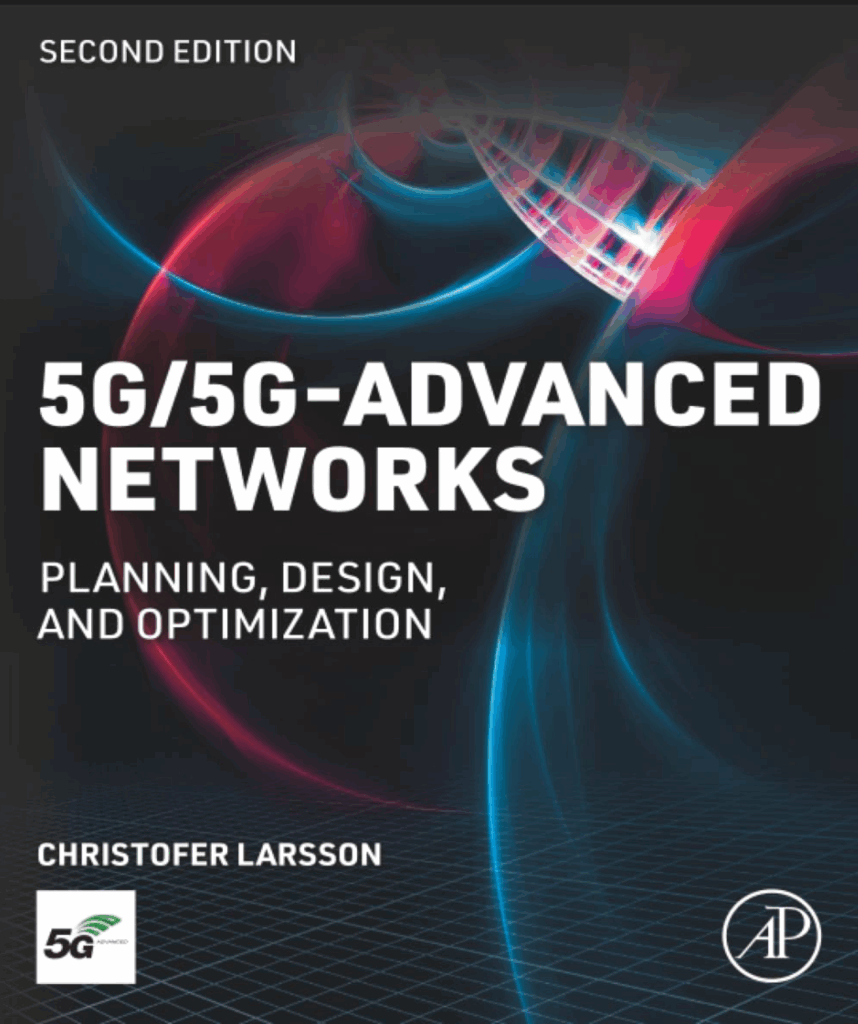
5G/5G-Advanced Networks: Planning, Design, and Optimization
Edition 2nd
This book by Christofer Larsson is a comprehensive technical reference focused on the architecture, planning, optimization, and operational management of modern 5G and emerging 5G-Advanced mobile networks. The second edition expands significantly on the original work by incorporating new chapters on information theory, radio planning, network slicing, heavy traffic analysis, and machine learning applications for network analytics and optimization. The book is intended for telecom engineers, researchers, operators, and graduate students seeking both theoretical foundations and practical engineering methods for designing next-generation wireless networks.
The book begins by explaining the evolution from previous cellular generations toward 5G and 5G-Advanced systems. It describes how the increasing demand for ultra-high bandwidth, low latency, massive connectivity, and improved reliability has transformed mobile network architecture. Unlike earlier generations, 5G is designed as a highly flexible and software-driven ecosystem capable of supporting diverse services such as enhanced mobile broadband, industrial automation, autonomous transportation, Internet of Things (IoT), and mission-critical communications. The author emphasizes that modern network design can no longer focus solely on radio access performance but must optimize the complete end-to-end system, including transport, cloud infrastructure, orchestration, and service delivery.
A major theme throughout the book is the transition toward virtualized and software-defined networking architectures. The author explains how software-defined networking (SDN) and network function virtualization (NFV) enable flexible deployment of network services and dynamic resource management. These technologies allow operators to create network slices tailored for specific applications with different performance requirements. The book discusses how network slicing supports industrial automation, IoT services, private wireless networks, and ultra-reliable low-latency applications while balancing operational costs and service quality.
The radio access network (RAN) receives extensive treatment. Larsson analyzes the role of massive MIMO, beamforming, spectrum utilization, and advanced radio planning methods in increasing spectral efficiency and network capacity. The book explains how 5G NR operates across multiple frequency ranges, from traditional sub-6 GHz bands to millimeter-wave frequencies, each introducing unique propagation challenges and deployment strategies. Special attention is given to dense urban deployments, interference management, coverage optimization, and mobility handling in heterogeneous network environments.
Another important contribution of the book is its focus on optimization techniques and mathematical modeling. The author presents algorithms and methodologies for network tuning, capacity planning, resilience improvement, and quality-of-service management. Multi-objective optimization is emphasized because network operators must simultaneously balance throughput, latency, reliability, energy efficiency, and operational costs. The book demonstrates how optimization problems in 5G networks are highly data-driven, high-dimensional, and dynamic, requiring advanced analytics and automation methods.
Machine learning and artificial intelligence form another major topic in the updated edition. Larsson explains how AI and ML techniques can improve traffic prediction, anomaly detection, fault management, self-organizing networks, and automated orchestration. The book discusses both offline analytics and real-time operational intelligence, highlighting the growing importance of data-driven network management as networks become increasingly complex. The integration of AI into 5G-Advanced systems is presented as a critical step toward future autonomous networks and eventual 6G evolution.
The book also addresses network resilience and reliability. Modern mobile infrastructure must support critical services where downtime or degraded performance may have serious consequences. Larsson explores methods for resilience measurement, redundancy planning, traffic engineering, and failure recovery. Heavy traffic analysis and congestion control techniques are examined in the context of increasingly dense and heterogeneous deployments. The author highlights the importance of observability, monitoring, and analytics frameworks for maintaining stable and predictable service quality under rapidly changing network conditions.
A distinctive feature of the book is its practical engineering orientation. In addition to theoretical discussions, the author includes implementation guidance, benchmarking approaches, testing methods, validation procedures, and examples using open-source tools and Python-based algorithms. These practical sections help bridge the gap between academic concepts and real-world deployment challenges faced by telecom operators and vendors.
Overall, 5G/5G-Advanced Networks presents a broad and detailed examination of how modern cellular systems are designed, optimized, and operated. The book combines telecommunications theory, systems engineering, data analytics, and operational economics into a unified framework for understanding the evolution of wireless networks.
It portrays 5G-Advanced not simply as a faster radio technology, but as a foundational platform for intelligent, software-defined, and highly automated communication infrastructures that will support the digital economy and pave the way toward future 6G systems.
Author: Christofer Larsson

Publisher: Academic Press
Reviewed by: Alex Apostolov USA
ISBN-10: 0443329400
ISBN-13: 978-0443329401