by Martin Pfanner, OMICRON electronics GmbH, Austria
Singing in a choir definitely means more than music: it means being heard… It creates meaning and belonging – values that are more important to us humans than many other things.
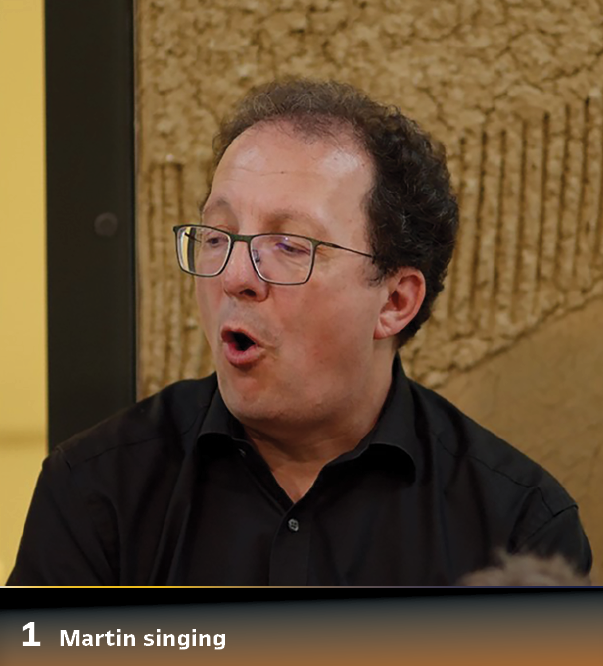
In my childhood I was surrounded by a lot of music. My parents loved listening to classical music. My mother and aunts often sang children’s and folk songs with me and my two brothers.
At the age of 7, I learned to play the soprano recorder and later the alto recorder at the local music school. At the age of 10, I switched to the clarinet and started my musical career with the brass band “Stadtmusik Feldkirch” as an eleven-year-old.
My youth was musically shaped by my participation in this orchestra with more than 60 musicians and numerous concert appearances at home and abroad.
Here I had the formative experiences of what it feels like to be part of a larger ensemble and to make a wide variety of musical works sound together. In addition to brass music, I also played a lot of music together with my brothers or in various formations of the music school.
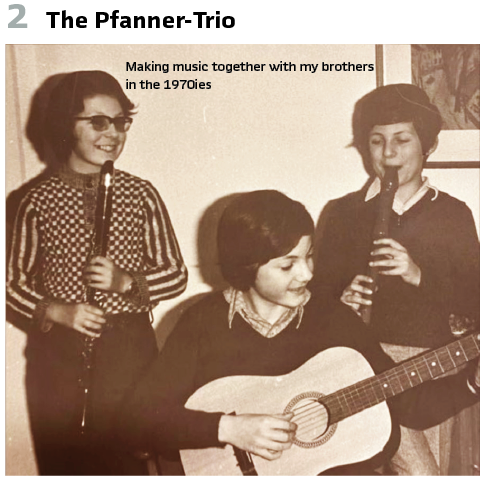
Singing only came back into my life when a friend of mine founded a youth choir in 1982, in which I was part of it from the beginning. We started as a small group of 6 singers and had a lot of fun singing together accompanied by a guitar. We started by musically arranging youth masses and bringing new momentum into the churches with our rhythmic songs. Soon we were also musically involved in the church festivals such as Christmas and Easter in our home church and sang at numerous weddings and baptisms.
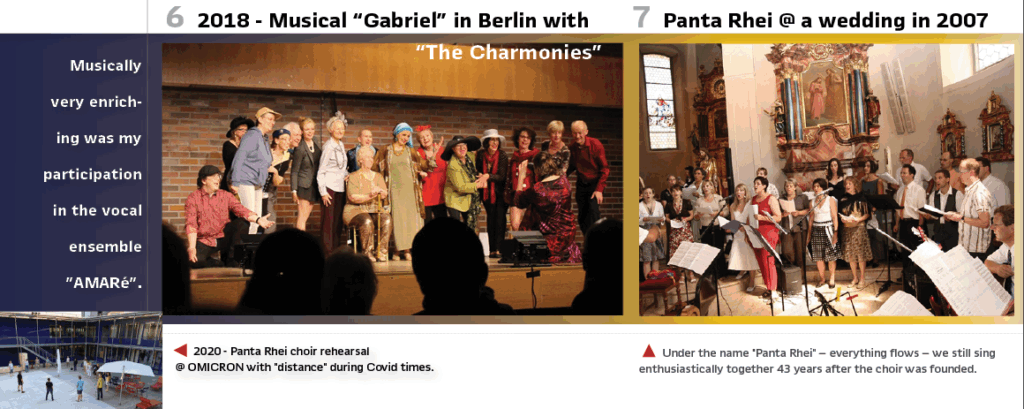
Over the years, our small youth choir grew into a stately mixed choir with over 30 members. Our repertoire became more demanding and also increasingly secular. Initially 2-part songs became more complex 4-part choral movements, which we now prefer to perform a capella, i.e. without instrumental accompaniment. Under the name “Panta Rhei” – everything flows – we still sing enthusiastically together 43 years after the choir was founded.

We perform 1-2 of our own concerts every year and help to create music for many events. Special highlights in the choir year are always the own concerts as well as the encounters and exchange with other choirs. In 2017, for example, we took part in a large choir festival with 30 other choirs in Wildschönau/Tyrol, where the choirs sang for each other and with each other for a whole weekend and the voices always only fell silent well after midnight.
In 2019 we sang a concert in Prague together with a Czech choir, and in 2025 the participation in the choir festival “Fire and Voice” in Lungau/Salzburg was the highlight of our choral year. At Panta Rhei, many friendships were formed for me that have lasted through the decades. (Figures 3 & 7).
What is the fascination of singing for me and has led to the fact that I never gave up singing in all the intensive professional and family years?
First and foremost, my experience was decisive here, how good singing with others is for me and how much energy and joie de vivre singing brings into my life. Very often I have experienced that after an intense day at work I came to the choir rehearsal exhausted or sometimes depressed and left it 2 hours later with new energy, a good mood and a head full of melodies.
Singing takes hold of my whole body, relieves tension and makes me loose and free again. In the choir I don’t sound alone but am in constant exchange with my fellow singers. Together we make melodies sound, create harmonies, express emotions or tell the story of a song.
I have experienced few other activities where I can leave my everyday worries behind so quickly and recharge my batteries.
Many scientific studies show that singing together promotes the release of happiness hormones such as oxytocin and endorphins, lowers cortisol levels and even activates the immune system. A Finnish long-term study found that people who regularly sing in a choir have higher life satisfaction and a significantly lower susceptibility to depression.
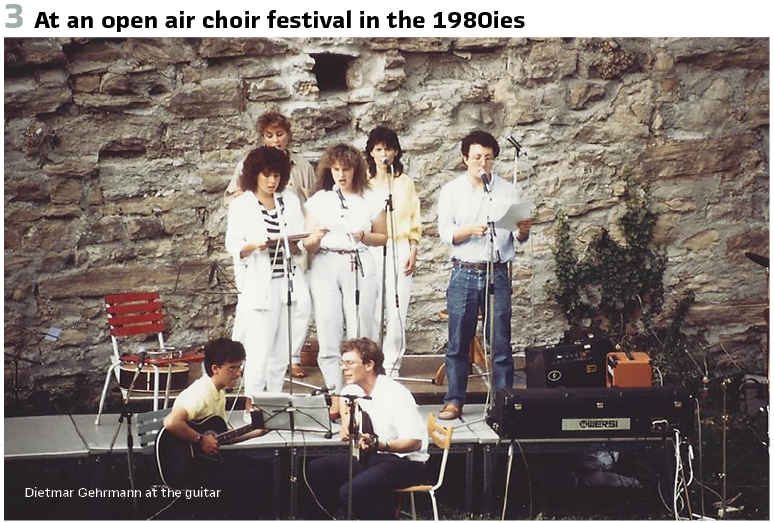
Singing in a choir definitely means more than music: it means being heard. It means being part of a whole, taking responsibility, listening to each other in the truest sense of the word. It promotes self-confidence, emotional expression and resilience. It creates meaning and belonging – values that are more important to us humans than many other things.
In the midst of an ever faster changing and very demanding world, singing together creates an antithesis: a protected space for creativity, connection and inner balance.
Those who sing breathe together. Those who sing feel together. And those who sing build bridges – between people, between generations, between cultures and religions.
I can only warmly recommend anyone who does not classify themselves as completely unmusical to make these experiences themselves.
For me, it has not remained with one choir over the years.
In 2007 I took part in an inspiring jazz and gospel week with the well-known Czech choir director and voice coach Jan Stanek at our Vorarlberg site. Repeated seminars led 3 years later to the founding of the project choir “Hlahol” (which means “with music to the heart”) under the direction of Jan Stanek. Some OMICRON employees were among the founding members.
We were able to give the choir a home for its rehearsal weekends for many years in our atrium with piano at the ODC in Klaus. Hlahol has met six times a year for a whole weekend at OMICRON for the past 14 years to rehearse for concerts and masses.
The repertoire was very versatile and ranged from Dvorak to gospels. It was a very enriching experience for me to sing under Jan’s choir direction. I have always been particularly impressed by his mastery of developing an excellent choral sound together with the singers.
In the years 2013 – 2015, I worked professionally for OMICRON in Berlin and joined the jazz choir “The Charmonies” there. Even after my return to Austria, I remained loyal to this choir until 2018 and we performed an annual musical in Berlin, which our choir director Elisabeth had composed especially for the choir (Figure 6).
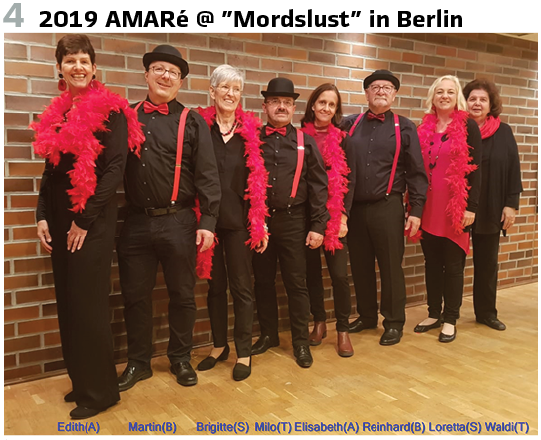
Musically very enriching for me was the participation in the vocal ensemble “AMARé”, a double quartet, in the years 2016 – 2020.
Making music together in such a small formation, in which each of the 4 voices is doubled, was even more immediate and challenging for me than participation in a large orchestra. Here it depends even more on each individual and it is even better to express the finest nuances in singing together.
A special feature of AMARé was that we had our entire repertoire ready by heart and were therefore ready to sing anytime and anywhere. I have fond memories of many beautiful, planned and spontaneous performances during our travels together.
When I heard in 2019 that the choir director of the Charmonies was now also publishing her own crime novels, we organized a reading combined with a joint concert of the Charmonies and AMARè with “criminal” songs and performed this format under the title “Mordslust” in October 2019 in Berlin. (Figure 4).
In 2020, many choral activities came to a standstill due to the inception of the worldwide Covid pandemic. Choral singing had suddenly become one of the most dangerous hobbies, public performances were completely prohibited, and rehearsals were only permitted with large distances between the singers. Fortunately, this phase is now behind us. Unfortunately, the AMARé ensemble did not survive the Covid break.
My most recent musical journey began when my long-time colleague at OMICRON, Tobias Schmutzhard, asked me in April 2022 if I could support the “Liedermännerchor Alberschwende” in bass at its anniversary concert for the choir’s centenary.
The song repertoire was very varied and ranged from Schubert to modern pop ballads, so I gladly accepted this challenge.
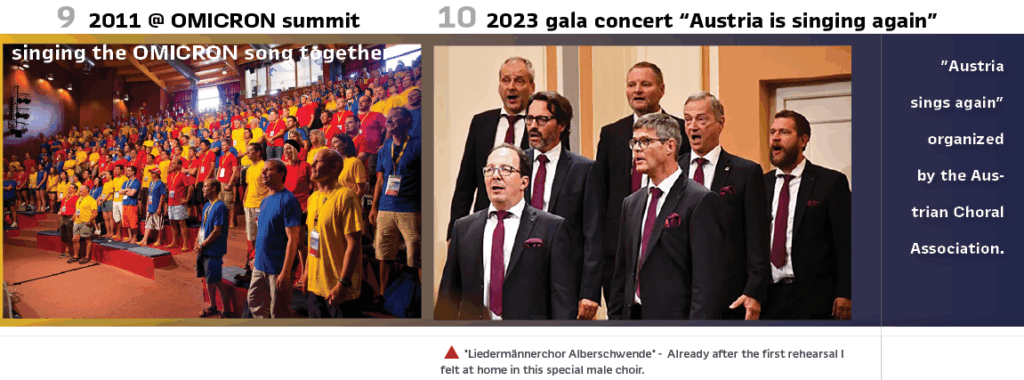
Already after the first rehearsal I felt at home in this special male choir. This was followed by 3 intensive weeks with 2 rehearsals/week including long debriefings over beer or wine, followed by 2 moving concert performances.
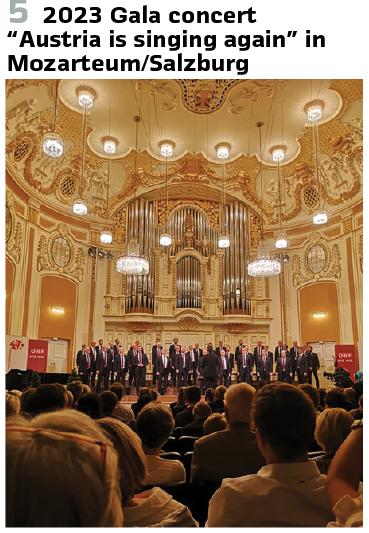
Since then, this choir has not let me go and the Liedermänner have become an integral part of my life. A very nice experience together was our participation in the gala concert “Austria sings again” organized by the Austrian Choral Association at the Mozarteum in Salzburg in autumn 2023, where we were allowed to represent the state of Vorarlberg.
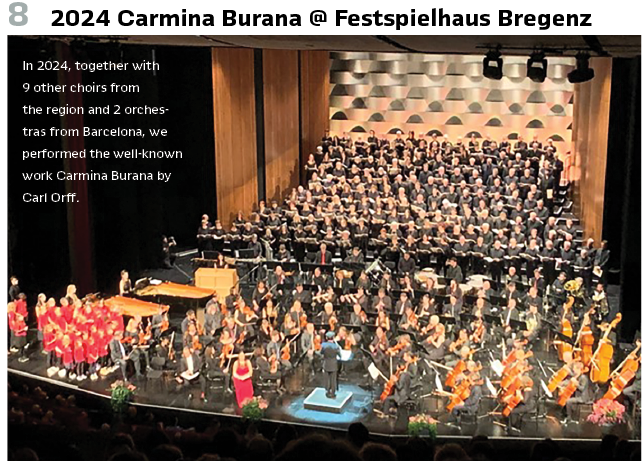
In 2024, together with 9 other choirs from the region and 2 orchestras from Barcelona, we performed the well-known work Carmina Burana by Carl Orff. (Figure 8).
Singing enriches my life in many ways. I can also apply many of the practices of choir singing in my daily work within the OMICRON team. We always achieve the best results when we operate like an orchestra being tuned to each other and making a common work resonate.
I would like to end my contribution with a statement that I recently made on the occasion of the presentation of a new songbook of our regional street newspaper “marie”: “Congratulations on the inspiring project “marie Liederbuch – Straßenfeger und Gassenhauer.”
Personally, I have often been able to experience how beneficial singing together with others was for me physically and mentally and what vitality I was able to draw from it. Singing together has the magic of connecting people across age, gender and ethnic boundaries and bringing about peace. This unifying power is sorely needed in our time.“
Biography:

Martin Pfanner studied electronics and communication engineering at the HTL Rankweil. After college he developed audio measurement equipment at Neutrik AG in Liechtenstein for 7 years. Martin joined OMICRON in 1990 as hardware developer for the CMC56. In the following years he contributed to OMICRON’s amazing journey in many different roles like innovation manager, CEO or business unit leader. Currently Martin is working as product manager for OMICRON’s primary testing software.