By Sylvie Perrin and Vincent Sermanson, RTE, France
The Iberian blackout that occurred on April 28, 2025, at 12:33 PM was classified as a Level 3 incident—the highest severity level under European regulations. It represents the most severe blackout in over 20 years and the first of its kind, characterized by a cascading overvoltage event.
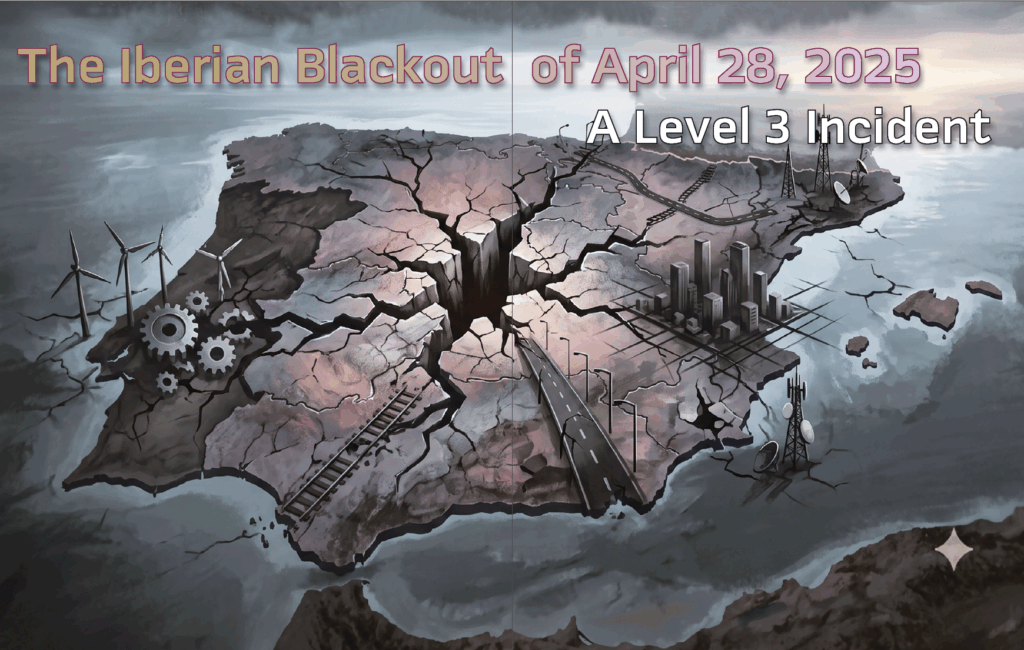
An Independent Expert Panel, established in accordance with European regulations, published a final report identifying the root causes of the blackout, providing a comprehensive overview of the factors contributing to its severity, and proposing technical and regulatory recommendations.
The report confirms that the blackout was not triggered by a single cause but resulted from the combined effect of multiple factors. Unstable voltage conditions and a rapid voltage rise led to cascading tripping events.
The root causes identified are linked to: i) The definition and control of protection settings for high-voltage events, ii) The definition and control of voltage regulation requirements, iii) Voltage control capabilities, iv) Safety margins.
The analysis does not attribute the incident to renewable energies or electrification as such, but instead highlights the need to adapt the regulatory framework and operational practices in response to the evolving European power system, while ensuring a balanced reliance on all types of generation.
On March 20, 2025, the independent panel commissioned by ENTSO-E published its final report on the root causes of the April 28, 2025, blackout that struck the Iberian Peninsula. The report contradicts initial claims blaming excessive intermittent renewable energies (IRE) and low system inertia, instead highlighting voltage management as the primary issue. It includes recommendations for Transmission System Operators (TSOs), Distribution System Operators (DSOs), and regulators, with additional lessons implied.
On April 28, 2025, at 12:33 PM (UTC), mainland Spain and Portugal suffered a near-total blackout, cutting power to over 50 million people. Outages lasted up to 16 hours in some Spanish regions, while a small area in southwestern France was briefly affected. The rest of the European grid remained stable.
A Turbulent Spring Morning on the Spanish Power System
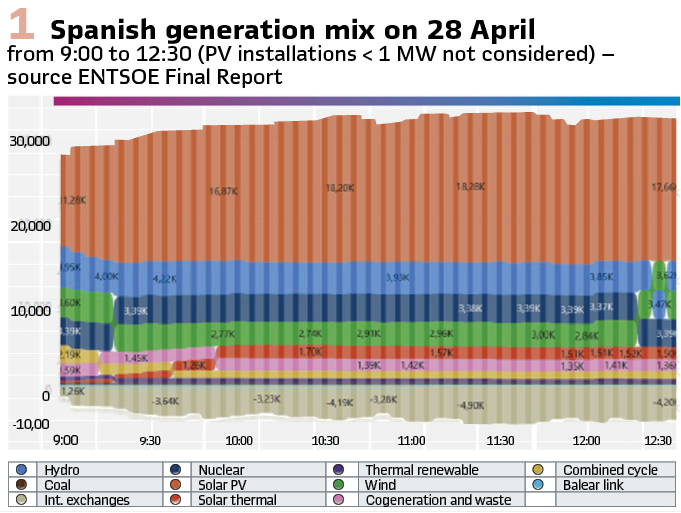
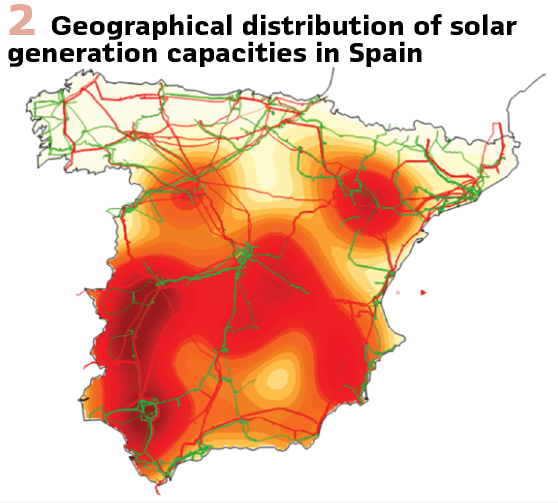
On April 28, 2025, demand, generation, and electricity exchanges were unexceptional—a typical spring day with moderate consumption (24.5–27 GW, vs. Spain’s January peak of 40.1 GW) and high renewable output, especially solar, which peaked at 21 GW at midday. Figure 1 shows Spain’s generation mix (excluding PV installations under 1 MW), and Figure 2 maps solar capacity distribution as of April 2025.
However, Spain’s TSO, Red Eléctrica, faced multiple simultaneous challenges. From 10:30 AM, voltage fluctuations became unusually pronounced. Operators responded to low voltages by connecting shunt capacitors, energizing 400 kV lines, and disconnecting shunt reactors. Within minutes, they had to reverse these actions as voltages rose, then fell again. Their response time—1.5 minutes after the first alarms—was considered rapid.
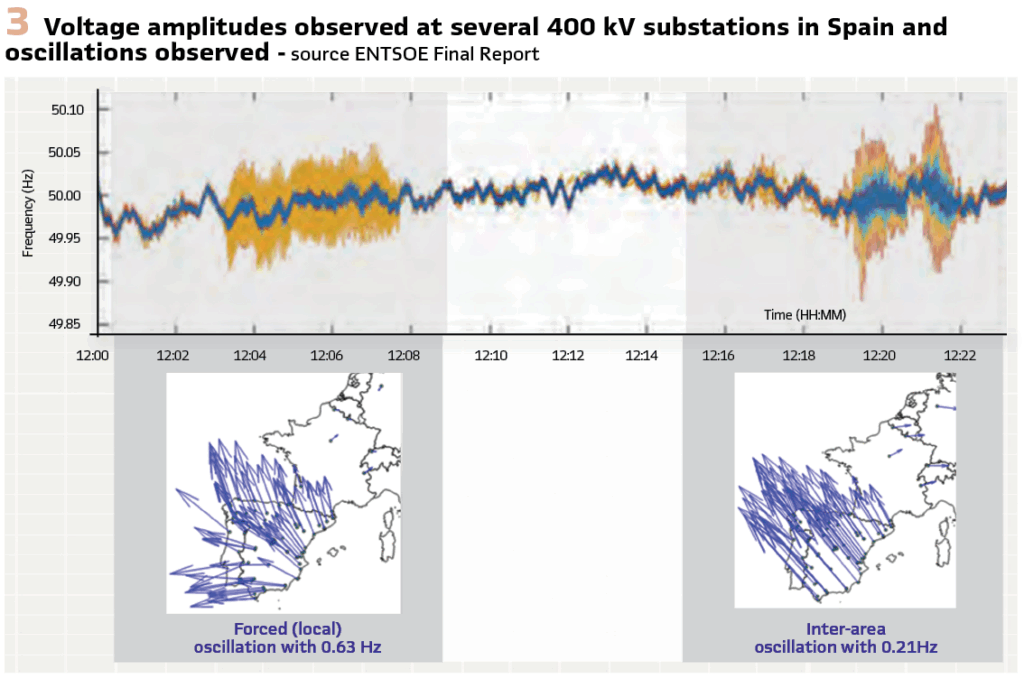
By 11:00 AM, and especially 12:00 PM, low-frequency oscillations worsened the situation. These inter-area oscillations (below 1 Hz) result from the Continental European grid acting like a spring, linking synchronous machines across regions. Normally well-damped, they became problematic in Iberia, causing voltage swings of several kilovolts and power flow variations of hundreds of megawatts. Operators followed procedures: reconnecting 400 kV lines, adjusting the Baixas–Sta Llogaia HVDC link, and reducing exports to France.
Yet, an unusual 0.63 Hz oscillation—never seen before or since—emerged. Simultaneously, the amplitude of the typical 0.2 Hz oscillation reached 200 mHz (vs. a 20 mHz detection threshold), with voltage swings up to 28 kV. The report notes inadequate response from some Power System Stabilizers (PSS) in thermal and hydro plants. While reconnecting 400 kV lines helped dampen the 0.2 Hz mode, it raised voltages, as lightly loaded 400 kV lines act like capacitors. (Figure 3).
At 12:20 PM, operators requested the start-up of a combined-cycle gas turbine (CCGT) with a Power System Stabilizer (PSS) to improve oscillation damping, but the plant did not synchronize in time before the blackout.
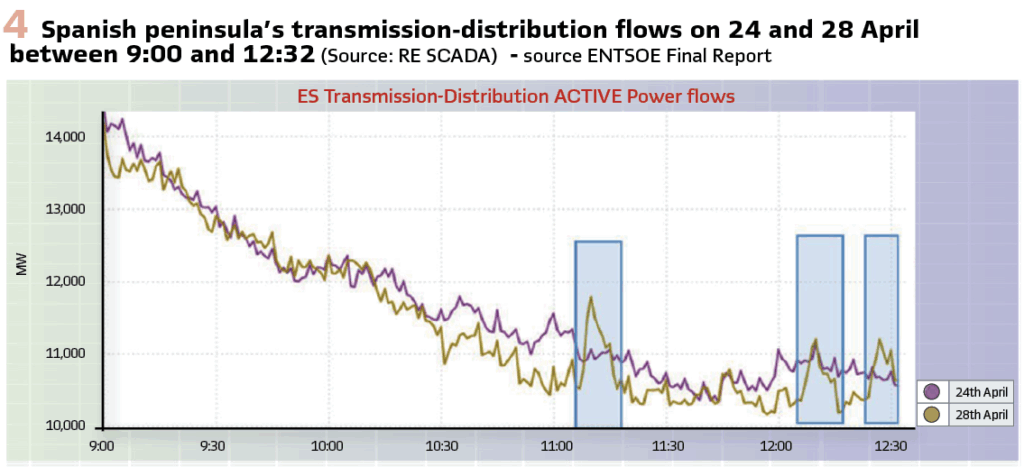
A third issue further complicated the situation: a sudden, temporary surge in distribution grid consumption, observed three times that morning. Figure 4 shows active power flows between TSOs and DSOs, reflecting these spikes. The cause was likely the disconnection of low-voltage photovoltaic installations due to overvoltage protection, along with increased consumption linked to rising voltages.
At 12:32 PM: System Runaway and Collapse: The April 28 blackout was not caused by a single event but by the convergence of multiple destabilizing factors:
1. Cascading Overvoltage: Tripping High voltage levels, low-frequency oscillations, and insufficient damping triggered the tripping of generators and compensation devices due to overvoltage protection, further weakening voltage regulation and stability.
2. Loss of Synchronism and Voltage Collapse: The rapid voltage rise and oscillations caused synchronous machines in Iberia to lose synchronism. The HVDC link with France (Baixas–Sta Llogaia) could not compensate for the reactive power imbalance, accelerating the collapse.
3. Final System Breakdown: At 12:32 PM, the system reached a tipping point. Voltage and frequency control mechanisms failed, leading to cascading disconnections and a near-total blackout across mainland Spain and Portugal, with outages lasting up to 16 hours.
The expert panel highlighted that the incident resulted from the cumulative effect of:
- Inadequate voltage control and protection settings,
- Insufficient damping of inter-area oscillations,
- Uncoordinated disconnection of distributed photovoltaic installations,
- Limited reactive power reserves and poor dynamic response from conventional plants.
This event underscores the need for improved grid resilience, especially with high renewable penetration.
Key Difference from Historical Incidents
Unlike past blackouts—often triggered by a single event (e.g., line disconnections in Chile, Germany, or Italy; generation loss in Texas or the UK)—April 28, 2025, was marked by a rapid voltage rise in southern Spain starting at 12:32 PM.
From 12:30 PM, wind and solar plants reduced active power output by ~500 MW. In Spain, renewable generators (unlike in other European countries) do not participate in voltage regulation; they operate at a constant power factor (cosφ). Thus, when active power drops, reactive power draw decreases proportionally, causing voltage to rise.
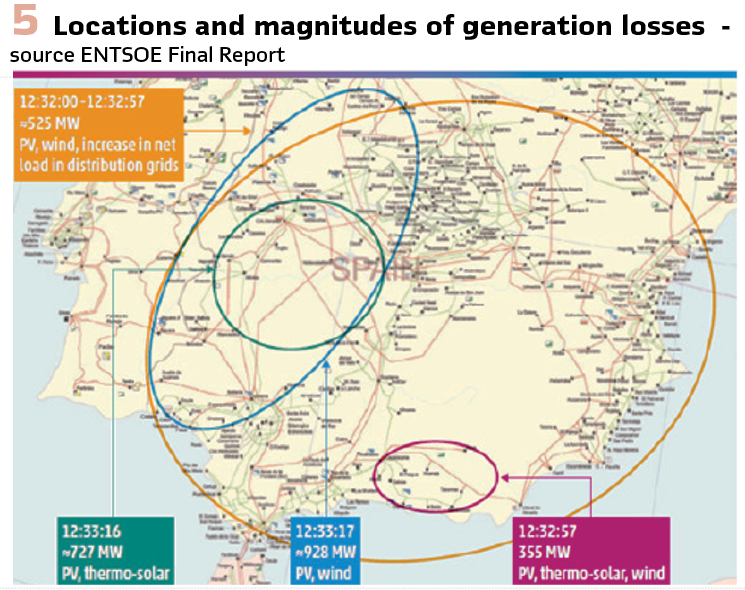
By 12:32 PM, multiple generators tripped due to overvoltage protection (see Figure 5). Each disconnection reduced voltage regulation margins and reactive power draw, worsening the high-voltage situation and triggering further tripping. Figure 6 shows the correlation between rising voltages in southern Spain and generation loss.
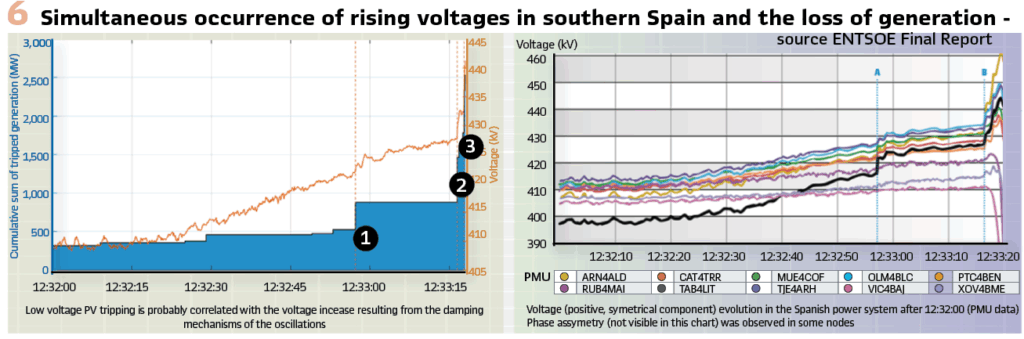
A snowball effect then unfolded—rapidly and uncontrollably. This runaway high-voltage phenomenon, though theoretically understood, had never been observed on such a scale. The time between the last overvoltage alarms and system collapse was just 38 seconds, leaving operators no chance to analyze, decide, or act. The best response would have been to activate the last available reactors to reduce voltages. Compounding the issue, one-third of Spain’s substations were experiencing overvoltage, further complicating analysis.
The report details the full timeline and notes that both transmission- and distribution-level generators tripped—before and during the voltage runaway. However, precise data on distribution-level disconnections was limited. The report highlights a clear correlation between the rapid voltage rise in southern Spain and the successive disconnections of generation assets.
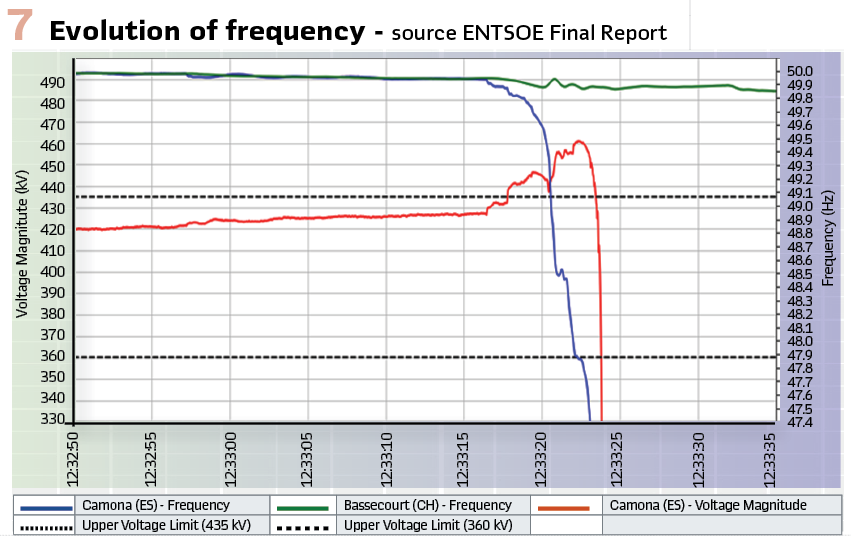
The loss of generation caused a frequency drop in Spain. While the French and European grids remained near 50 Hz due to their inertia, Spanish machines slowed, leading to a loss of synchronism. Severe voltage and power fluctuations risked damaging turbo-alternator shafts.
At RTE (French TSO), Synchronism Break Disconnection (DRS) protections automatically opened the interconnection lines between Spain and France to prevent the incident from spreading. The Iberian Peninsula was thus isolated from continental Europe. The synchronous link with Morocco had already disconnected one second earlier, triggered by under-frequency protection. (Figure 7).
At 12:33 PM, after the separation, the Spanish and Portuguese grids faced a severe power deficit with no external support. Iberia’s generation capacity was insufficient, causing frequency to collapse. The automatic load-shedding plan activated in six stages, targeting pumped-storage plants and consumer loads.
However, its impact was limited: distributed generation was shed alongside loads, and voltage rises from load-shedding worsened generation losses due to overvoltage.
In southwestern France, nineteen small hydro plants and a 1,300 MW nuclear unit disconnected after the separation and power surge, but without further consequences. In the French Basque Country, 7 MW of load was lost and restored within 20 minutes.
The Decisive Role of Simulations in Understanding the Incident
To understand the physical phenomena and mechanisms at play, it is essential to reproduce the sequence using models and simulations. Once validated against measured data, these simulations not only allow for the reconstruction of electrical parameter trajectories but also enable the testing of alternative scenarios by answering questions such as: “What would have happened if…?”
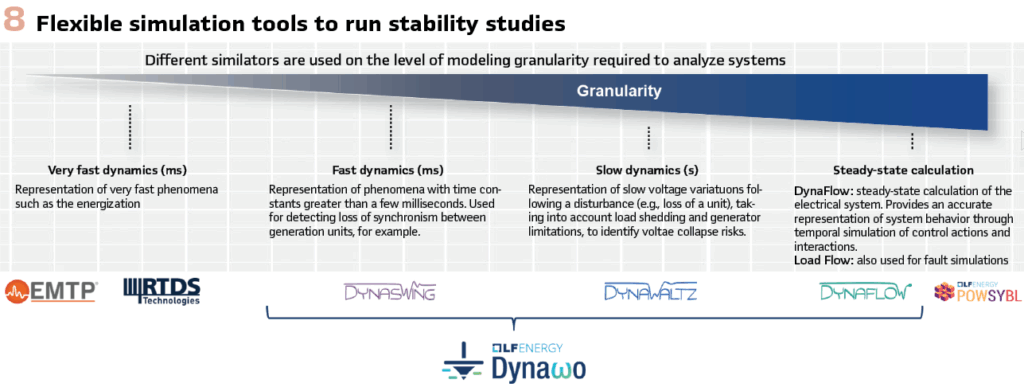
RTE has developed and deployed over several years a suite of high-performance and flexible simulation tools, designed to meet today’s needs and anticipate future challenges. (see Figure 8).
This “replay” process is inherently complex due to the vast number of variables to consider and their time-dependent variations. In this case, it was made even more challenging by the lengthy and delicate data collection process, as well as the lack of sufficiently detailed information on certain phenomena—particularly in distribution networks or among power producers. Despite these constraints, experts, including those from RTE and TERNA (the Italian transmission system operator), successfully reconstructed the key trends in oscillations and voltage evolution. By testing variants, they were able to assess the relative impact of different factors in the progression of the incident.
The analyses demonstrate that it would not have been possible, in the hours leading up to the event, to anticipate the highly specific conditions that led to the blackout on April 28 at 12:33 PM—particularly the observed oscillations, the operational measures they triggered, and the subsequent voltage rise. They also highlight that it would not have been economically justifiable to keep gas-fired power plants online solely as a preventive measure, given the information available at the time of the decision.
Modal analysis of the low-frequency oscillations confirms that the 0.2 Hz mode corresponds to the well-known European inter-area mode. The analyses further reveal that the 0.63 Hz mode is unprecedented, localized to the Iberian Peninsula, and not amplified by the electrical system. It is very likely a forced oscillation linked to inverters. Two distinct analytical methods converge in identifying a plausible source: a grid-connected inverter-based plant in the Badajoz region, whose contribution to the 0.63 Hz oscillations appears significantly higher than that of other installations.
Further studies demonstrate that a higher level of inertia would not have altered the outcome of the incident. However, simulations confirm the central role of rapid voltage variations in the dynamics of the event. They identify several key factors, particularly the decisive influence of power fluctuations exchanged with distribution networks. They also highlight that certain measures taken to dampen low-frequency oscillations, such as the reclosure of 400 kV lines and the reduction of power exchanges between Spain and France, contributed—as expected—to raising voltage levels.
The simulations further demonstrate that additional absorption of reactive power by conventional power plants or by shunt reactors that remained disconnected would have helped keep voltages below 420 kV. However, the report’s authors remain cautious and do not claim that these voltage management measures alone would have been sufficient to prevent the incident.
A combination of factors that led to the blackout.
At the time of the incident, Spain lacked regulatory requirements for wind and photovoltaic plants connected to the transmission grid to support voltage control. Operating in constant power factor mode, their production variations directly caused reactive power—and thus voltage—fluctuations.
No speed limits were imposed on production changes. These regulations, dating back to March 2000, were updated in June 2025. Spain also allowed a maximum voltage of 435kV (vs. 420 kV in most EU countries), leaving only a 5 kV margin before hitting generator protection thresholds (440kV or 435kV). This increased the risk of generator tripping during overvoltage events.
Other critical factors included:
- No automation for shunt reactors or capacitors, leaving operators just 38 seconds to react before collapse
- No criteria or penalties for the dynamic response of voltage control mechanisms in conventional plants
- Unexpected issues worsened the situation:
- Conventional plants provided less reactive power than expected
- Some generators’ overvoltage protections activated at non-compliant thresholds
- Operators lacked time to deploy all manual voltage management measures
Reduced exposure and enhanced protection in France, despite the absence of zero risk
In France, RTE limits normal grid voltages to 420 kV (vs. 435 kV in Spain), with a generator disconnection threshold of 440 kV, matching the rest of Europe. This extra margin reduces the risk of mass tripping during disturbances.
RTE also benefits from:
- Broader participation in voltage regulation, including renewables, which are required to support system voltage control. This is automatically coordinated via Secondary Voltage Control (SVC), a system shared only with Italy in Europe
- Automated systems for switching shunt capacitors or reactors, reducing operator workload during incidents or sudden voltage fluctuations
Additionally, RTE enforces compliance with voltage control requirements through:
- Penalties for non-compliance
- Pre-commissioning and decennial inspections of generator protection settings
These measures help mitigate voltage runaway risks, though no system is entirely risk-free.
Twenty-One Recommendations to Strengthen Security Margins in Europe
The Expert Panel’s report includes 21 recommendations to prevent a similar incident in Europe, addressed to regulators, power producers, TSOs, and DSOs. Many align with measures already in place in France, such as:
- Automating and coordinating voltage control devices
- Monitoring compliance with technical requirements for grid-connected producers
- Developing a dynamic European data model to estimate forced and interarea oscillations
The report validates ongoing French initiatives, including:
- Ensuring all generation and storage assets (e.g., photovoltaics at night) contribute to voltage regulation Deploying high-precision sensors (PMUs)
- Improving detection and analysis of low-frequency oscillations
- Implementing automated switching for shunt reactors based on voltage criteria
Efforts are also underway to strengthen the “defense plan”—the power system’s last protective barrier—against high-voltage phenomena.
To prevent disconnections during disturbances, stakeholders must:
- Define, validate, and monitor the capabilities of grid-connected installations, including:
- Voltage regulation performance (dynamic response)
- Resilience to common disturbances (e.g., voltage dips, temporary overvoltages)
Key Lessons and Future Outlook
The post-incident analysis highlighted the significant challenges in obtaining complete, synchronized, and sufficiently detailed data within a reasonable timeframe to fully understand the technical mechanisms at play. Many uncertainties remain, particularly regarding:
- The behavior of protection and automation systems at generation sites, and
- Events occurring in distribution networks
Producers, DSOs, and TSOs cited technical difficulties in retrieving and aligning data, as well as confidentiality constraints, to explain these gaps.
The April 28 incident is also notable for the absence of a clear, identifiable triggering event in the early stages of the analysis. Without an obvious cause, initial external assessments focused heavily on frequency and inertia, as these data are publicly accessible. While the in-depth analysis of root causes and key mechanisms necessarily took time, biased narratives emerged, particularly in France, blaming renewable energy as the obvious cause. In Spain, a particularly intense debate unfolded between public and private energy sector stakeholders, driven by major economic stakes and even political tensions.
Beyond the sometimes-oversimplified debates about the role of renewables in the energy mix or the functioning of electricity markets, a critical question has emerged: the electrotechnical requirements imposed on grid-connected installations, such as:
- Voltage and frequency regulation
- Inertia contribution
- Resilience to voltage dips, overvoltages, and frequency excursions, and
- Short-circuit behavior
Some of the experts’ recommendations require a revision of European grid connection codes.
The update of the Requirements for Generators (RfG) code, which sets harmonized standards for generation and storage units, was proposed by ACER in December 2023 but still requires approval and publication by the European Commission to take effect. While most TSOs are anticipating some of these requirements at the national level under their own regulations, the publication of RfG 2.0 remains essential to ensure consistent and harmonized implementation across the interconnected European system.
Furthermore, the growing role of distribution networks in connecting intermittent renewables requires stakeholders to adapt their operational practices. In France, balancing the needs of:
- Distribution grid operational constraints (sometimes linked to safety requirements), and
- The overall security of the electricity system is currently the subject of in-depth discussions
Additionally, the number of devices and stakeholders connected to distribution networks now runs into thousands or even millions in low-voltage (230V single-phase) networks. Monitoring electrotechnical behavior and ensuring compliance at this scale presents a major challenge for all system stakeholders.
A Turning Point for Europe’s Energy Transition
The April 28, 2025, event provides grid operators, producers, regulators, and all European electricity system stakeholders with a valuable opportunity to draw concrete lessons and strengthen system security. This reinforcement is essential to successfully decarbonize the economy and, in doing so, build Europe’s energy sovereignty.
Biographies:

Sylvie Perrin is Deputy Director of R&D at RTE, where she previously served as Director of Stability Processes Transformation and Manager of the Voltage, Stability, and Protections Department. Her main challenge will be to work on the strategy of the R&D for the next years, going from Social Sciences to asset management and dynamic behavior of the grid. She is president of the French CIGRE Women in Energy group. Before joining RTE, she was Deputy Head of the Power Systems and Energy Markets Department at EDF Lab R&D, focusing on energy transition, regulation, market design, and grid integration of distributed resources. She also led teams at an Energy Transition Institute on innovative photovoltaic technologies.
Her career reflects expertise in innovation, grid stability, and energy transition.
Vincent Sermanson graduated from Supélec (Power Systems Department) in 1996. He began his career with research positions at the University of Liège, Belgium, and later at the Electric Power Research Institute (EPRI) in Palo Alto, California, USA. He subsequently joined EDF and later RTE, where he was responsible for the development and application of dynamic simulation tools and power system studies within the R&D teams.
Today, Vincent is a Senior Planning Studies Engineer and Power System Dynamics Expert at RTE. He represents RTE within the ENTSO-E System Protection and Dynamics Subgroup and serves as the French representative in CIGRE Study Committee C1 (Power System Development and Economics).