by Birkir Heimisson, Landsnet, Iceland
Six years into Landsnet’s (Transmission System Operator of Iceland) digital journey, it is a good time to pause, reflect, and look ahead. Since 2019, when the company took the strategic initiative that all new and refurbished substations should be built as fully digital substations — based on IEC 61850, a multi-vendor approach, and the use of Low Power Instrument Transformers (LPITs) where applicable — significant progress has been made.The rollout of these digital substations is not just about implementing cutting-edge technologies, but also about strategically adapting the mindset of the people involved. As our industry is conservative by nature, it always takes a considerable amount of patience to learn, understand, educate, and build trust in new ways of doing things.
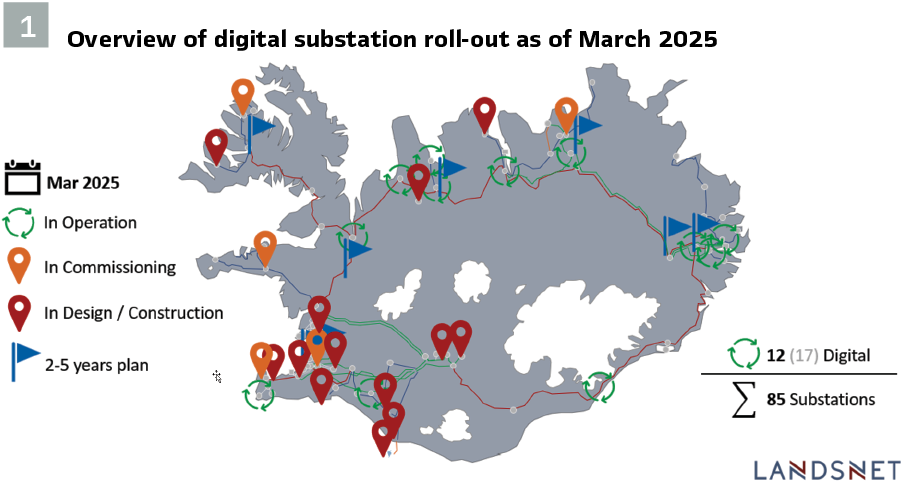
We have focused on adapting and modifying previous processes by utilizing the core principles of IEC 61850 to drive efficiency, standardization, and innovation across the entire substation lifecycle. As of now, we have 12 sites already in operation as fully digital substations, 5–6 stations undergoing commissioning, and many more planned. See Figure 1 for a status overview as of March 2025.
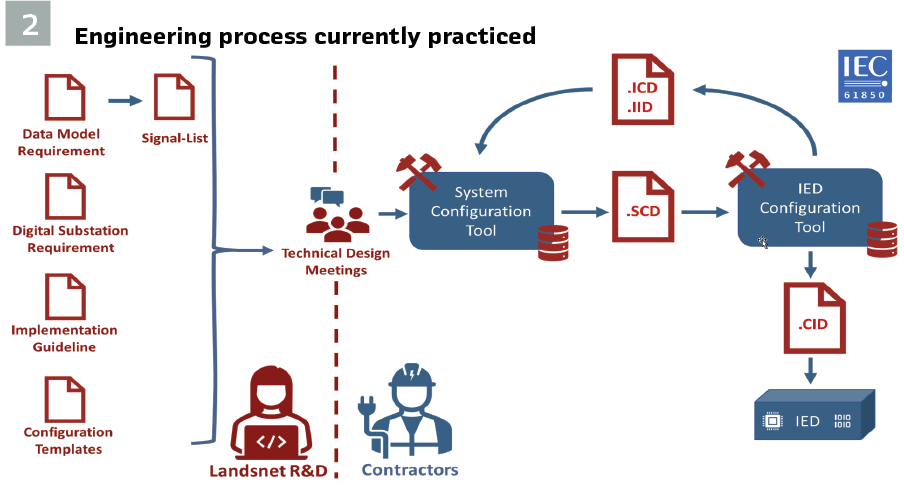
Landsnet’s approach to adapting to the digital transition was a learn-by-doing method, in other words, jumping into the deep end of the pool and learning how to swim. In the beginning, there was little more than a simple reference to the IEC 61850 standard in the tender documents. However, Landsnet quickly realized the need for more detailed requirements and implementation specifications to match the level of design standardization necessary for the sustainable operation of this innovative technology. This ranged from the standardization of signal definitions to the development of IED configuration templates. All of this work regarding Landsnet’s own specifications was not the result of an overnight decision, but rather a continuous improvement process with multiple iterations of design implementation. In regard to IEC 61850 engineering, Landsnet initially chose to adapt its data models to align with the approved vendor IED data models in order to enable fast project rollouts. This approach included the use of generic logical nodes and proper device modeling with functional allocation, minimizing the use of GGIO and GAPC nodes. In the near future, Landsnet plans to explore the maturity of vendor flexibility to define custom-specified data models using the System Specification Description (SSD) method, in which the IED data models are adjusted to match customer-specified structures. Such an approach will allow even greater standardization for utilities and customers, making the operation and maintenance of digital substations more streamlined. The approach that Landsnet has been following is illustrated in Figure 2, where Landsnet provides multiple sources of information to the contractor/system integrator, who then handles the SCD top-down engineering with close follow-up through regular technical design meetings with Landsnet.
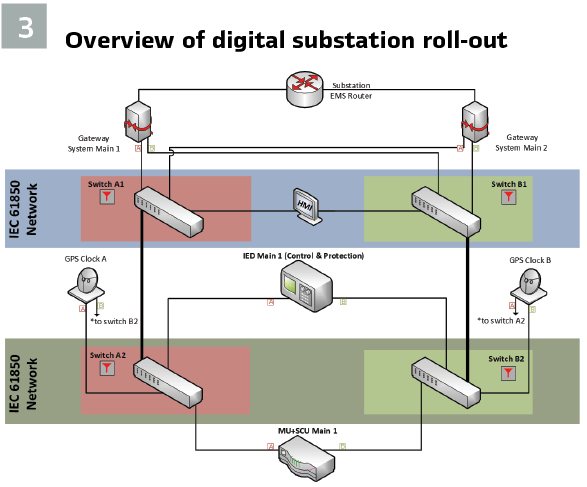
Standardization of the architecture for protection and control systems has also been a key part of the journey. The solution evaluates the category of the substation projects, where the highest priority substations require Main 1 and Main 2 device redundancy (e.g. IEDs, MUs/SCUs, Gateways). There is always a mandatory requirement for redundant time servers. The chosen network redundancy method is the Parallel Redundancy Protocol (PRP), as it allows for better scalability and traffic management. Landsnet also decided to combine the concepts of station-bus and process-bus into a single subnet, enabling a reduction in the number of ports and network switches, and resulting in a simpler network architecture. Alongside this decision, there is a mandatory requirement for optimized traffic management, where network filtering is essential — similar to terminal drawings in conventional substations. The use of destination MAC address filtering and/or VLANs is critical for the filtering of Layer 2 traffic. Recently, there have been improvements in tools and methods that allow automatic tailoring of the network communication design based on properly engineered SCD files, specifying almost all required data flows.
Redundancy in time synchronization with PTP has also improved, with recent advancements allowing both PRP interfaces to expose the same Grand Master Identity in the PTP packets. Other architectural decisions and guidelines include arrangements for redundant functions and their allocation on redundant devices — for example, device arrangement for power transformers and the implementation of backup controls for circuit breakers on the Main 2 systems. (Figure 3).
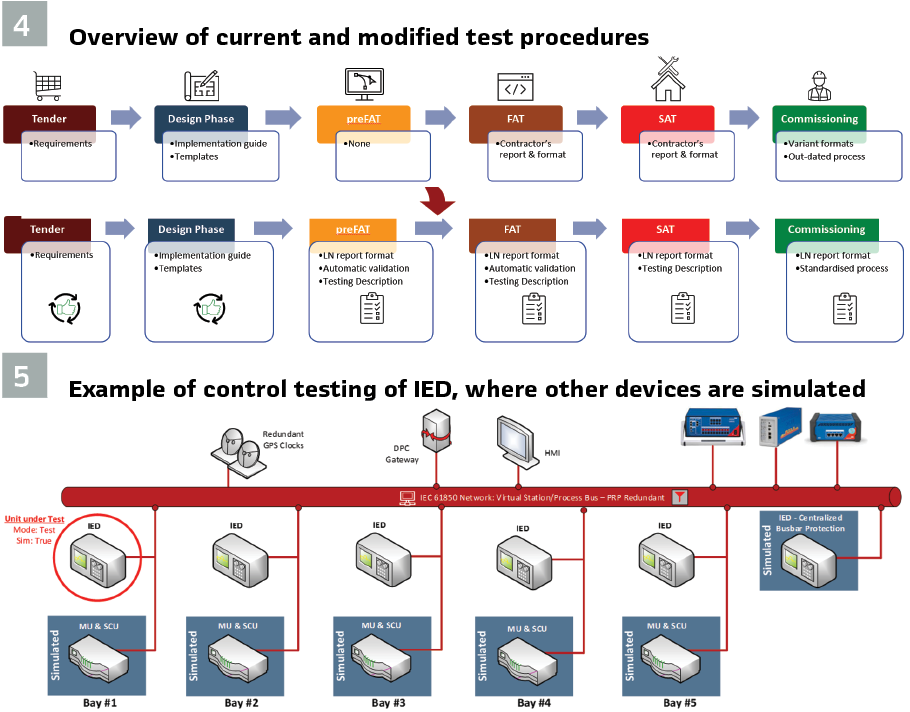
With the steep learning curve of the digital transition — mixed with the Icelandic attitude of “Þetta reddast” (English: “it will all work out in the end”) — the pre-existing testing and documentation processes have remained in use over the past five years, despite being outdated and showing clear room for improvement and modernization to meet today’s expectations for efficiency and reliability in digital substation testing. A high-level overview of the current process and the anticipated changes as part of the ongoing revision work is shown in Figure 4. Landsnet is working on harmonizing the reporting format that different contractors and system integrators must follow during the various test stages of the projects. The same reporting format will also be used by Landsnet’s own commissioning crews.
The new reporting format will consist of comprehensive checklists that reference standardized test descriptions and methods to ensure an acceptable and consistent approach for each test element. These descriptions will clearly specify and require the use of methods such as the IEC 61850 simulation flag (sim-flag) and test-mode functionalities. This approach will converge the testing methodologies of contractors and Landsnet’s internal testing crews, leading to more consistent and reliable outcomes. Additionally, the upgraded process will introduce a pre-FAT (Pre-Factory Acceptance Test) stage, aimed at standardizing configuration and implementation through manual and/or automated processes to validate the configuration and SCD engineering according to Landsnet’s implementation guidelines.
Here are examples of test specified in these standardized test procedures.
System Tests
- Network test
- PRP Redundancy
- Network management
- Filtering
- Traffic
- Bandwidth
- Device power-off checks
- Verification of correct PRP connections for all devices
- Time Synchronization
- Sync in accordance with PRP redundancy
- Hold-Over times
- Grand Master (GM) change-over
- Merging Unit Performance
- Accuracy validation with Primary Injections
- Hold-Over performance
- SmpSynch / GMid validation
- Reporting MMS for Gateways & HMI
- Checks if MMS is connected via Report Control Blocks (RCBs) instead of polling
Control Testing
Interlock checks can be fully automated by preparing comprehensive test plans prior to the Factory Acceptance Tests (FATs) and making use of the IEC 61850 test-mode and sim-flag. Figure 5 shows a test setup where the Bay #1 IED is under test for interlocks, while the remaining IEDs and MUs/SCUs are being simulated.
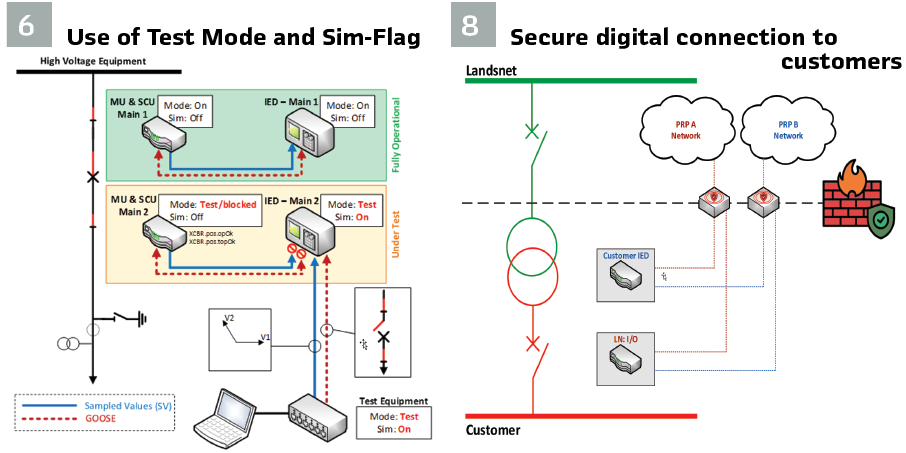
Other control or protection functions can be tested at all stages — including FAT, SAT, commissioning, and maintenance (even outage-less maintenance), by using IEC 61850 test methods. Figure 6 shows a case where the synchro-check function is being tested on the Main 2 system while the Main 1 system remains fully operational and continues protecting the asset.
Protection Testing
Protection testing is being improved, and automation options are being explored as part of the digitalization efforts. Landsnet is continuously working on tools and methods to convert protection settings into IED-readable formats (e.g., XRIO) in order to minimize human errors during parameter input and reduce the need for manually setting up protection test files. IEDs are also configured with special GOOSE datasets containing the complete set of protection system signals, which do not have subscribers during normal operation. However, protection test-sets can subscribe to these GOOSE messages, enabling a more concrete and detailed assessment of protection function performance compared to the traditional testing methodology, which relied mainly on start and trip digital contacts.
Signal Testing
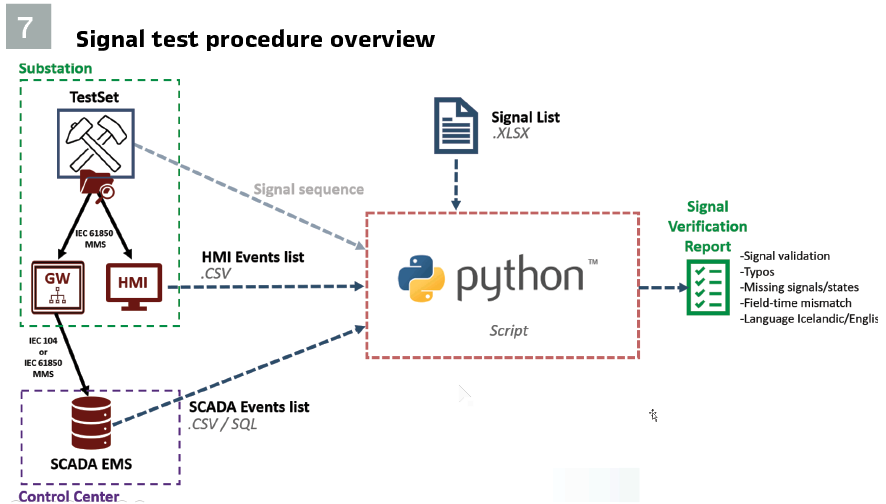
Signal tests — where all defined signals according to the project’s signal list are validated both in the substation HMI systems and in the Dispatch Center SCADA system — used to be among the most tedious and time-consuming tests. Each signal, often numbering in the hundreds to thousands for each substation, had to be manually assessed by visual confirmation from a commissioning engineer. With the digital substation journey, there was an opportunity to improve this overall process. It began with efforts to standardize the signal list and create IEC 61850 data model references for each signal, along with corresponding IEC 60870-5-104 addresses (awaiting the Dispatch Center SCADA upgrade to fully handle IEC 61850, at which point IEC 104 can be eliminated). When it came to testing, the configuration of the EMS/SCADA system could now be validated automatically against the standardized signal list. The substation gateway could be tested by simulating IEC 61850 signals, with the assessment performed on the IEC 104 interface. Finally, a complete end-to-end test would be conducted, as illustrated in Figure 7, where all IEC 61850 signals are simulated sequentially. Afterward, event logs from both the HMI and the EMS/SCADA systems are fetched and compared with the signal list using a Python script. The validation output is very strict, detecting issues such as typos, misconfigurations, timestamp mismatches, inversion errors, and category mismatches. This new testing methodology compresses what used to take days or even weeks into just 1–3 hours, while providing highly accurate results on the implementation.
As Landsnet is already well advanced in the adaptation of digital technologies within the PACS and substation domain, there are still many opportunities to utilize the technology to an even greater extent. The following topics are currently being explored and tested.
Virtualization
The centralized/virtualized topic is being tested and will be logical next steps in the digital journey when products are more commercially available. As we already have multiple digital substations there will be easy transitions for virtualization testing as it only requires software configuration, and the new servers can connect to the existing network and infrastructure. Initial testing can even be carried out in passive mode and then later enabled.
Digital integration with customers
The trend toward digital substations based on IEC 61850 has sparked significant interest among many customers within Iceland. There are already several projects underway where digital and secure integration is being implemented between Landsnet and customers such as DSOs, load consumers, and power producers. In these projects, secure network equipment (e.g., SDN) is installed to tailor communication at the Layer 2 level for IEC 61850 protocols (SV and GOOSE) between the companies. A demonstration of such connections is shown in Figure 8.
Digital Transmission System
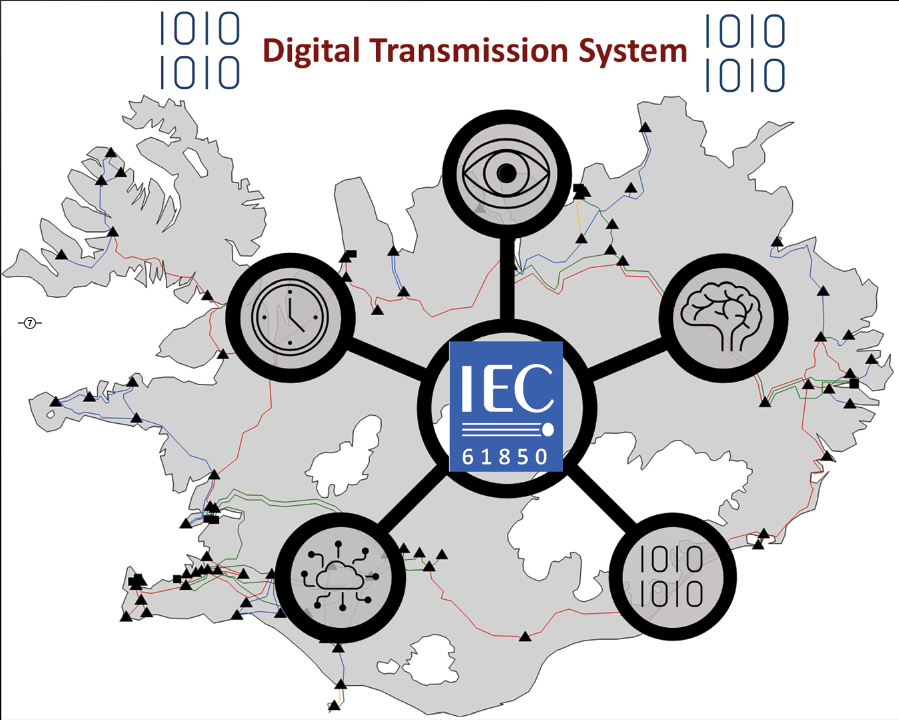
The concept of a digital transmission system is an extended evolution of the digital substation, introducing a state-of-the-art communication system that interconnects all substations within the power system. It enables options for land-based time synchronization, making the system more resilient against the loss of GPS-based time synchronization — ensuring time remains traceable to UTC. The concept also introduces greater flexibility by allowing IEC 61850 data to be shared in a sustainable, reliable, and secure manner between any substations within the grid. This opens up the possibility for Sampled Value (SV)-based differential protection, thereby eliminating vendor and device dependencies for differential protection schemes and their operations. Furthermore, it provides greater flexibility and enables enhanced protection and smart grid development, supporting the more dynamic and complex operations required by future power systems.
Biography:

Birkir Heimisson – is a Specialist in Digital and Smart-Grid Development at Landsnet. He Received his B.Sc. in Electrical Engineering from University of Iceland in 2011 & M.Sc in Electric Power Engineering from Chalmers University in 2014. He joined Landsnet (TSO of Iceland) as a system operator in 2014. Together with system operation, he led the Smart-grid development with focus on Wide-Area-Measurements and Control. Additionally, Heimisson was work-package leader for Landsnet in EU Horizon 2020 MIGRATE project. In 2019, he moved to research and development, where he focuses on Digital Substation implementation based on IEC 61850 and Smart-Grid Development.