By Alexander Apostolov, USA
Fault Location, Isolation, and Service Restoration (FLISR) is a key distribution automation technology used by electric utilities to enhance grid reliability, reduce outage durations (often from hours to seconds), minimize the number of affected customers, and support self-healing grid capabilities. It automatically detects faults on distribution feeders, pinpoints or approximates their location, isolates the faulted section (typically by opening automated switches or reclosers), and restores power to unfaulted sections by reconfiguring the network (e.g., closing tie switches to transfer load to adjacent healthy feeders or sources).
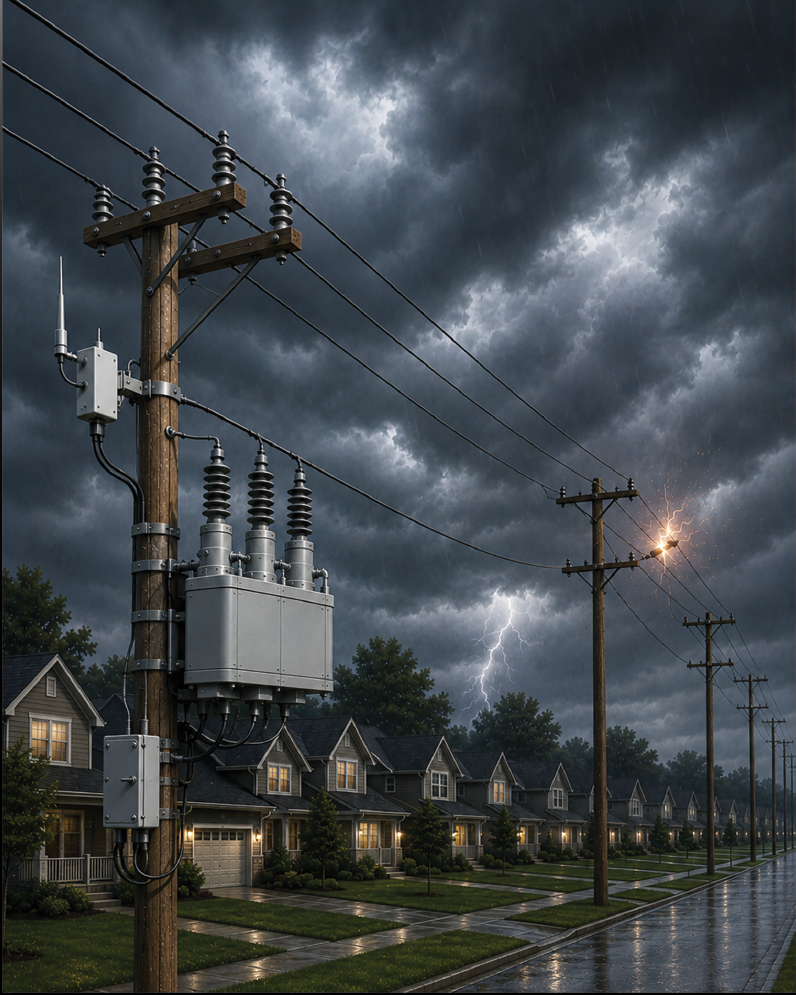
FLISR applications vary based on architecture, decision-making location, communication requirements, scale, and integration level. The following is a detailed list of the main types/categories of FLISR applications commonly deployed or discussed in the utility industry:
1. Non-Communication / Local-Logic FLISR (Decentralized, Peer-to-Peer without comms)
2. Peer-to-Peer with Communications
3. Distributed-Intelligence / Decentralized
4. Substation-Based FLISR (Substation-centric)
5. Centralized / Model-Based FLISR
6. Hybrid FLISR
These FLISR applications are deployed by utilities because of benefits including major improvements in SAIDI/SAIFI reliability indices, regulatory compliance, and customer satisfaction. The choice of scheme depends on network topology, budget, desired restoration speed, number of automated devices, and whether the goal is basic sectionalizing or full system-wide self-healing.
Fault Location, Isolation, and Service Restoration (FLISR) Basic Principles
The basic operating principles of FLISR can be explained using the Non-Communication / Local Logic FLISR. It is a fully decentralized approach, that operates purely on local measurements of voltage and current at each intelligent electronic device (IED) and achieves “peer-to-peer” coordination through the physics of the power system itself-voltage drops, current flows, and carefully engineered time delays. It is particularly well-suited to simple looped radial topologies and eliminates the need for communications infrastructure, cybersecurity concerns, or latency issues.
At its heart, Non-Communication Local-Logic FLISR leverages three fundamental functions built into modern recloser controls and sectionalizing switches:
1. Local sensing of voltage and current: Microprocessor-based recloser IEDs continuously monitor phase and residual voltages, line currents and fault magnitudes. No external data links are needed; every decision is based solely on what the device “sees” at its terminals.
2. Switch-onto-fault relay logic: A normally-open tie recloser or switch is programmed to close automatically after detecting a sustained loss of voltage on its line side (undervoltage element with adjustable pickup and definite-time delay). If the section it energizes contains a permanent fault, the downstream device immediately detects overcurrent and trips to lockout. The brief energization of the fault (typically 100–500 ms) is acceptable because modern reclosers are designed to handle momentary fault currents, and the fault is isolated before any significant thermal or mechanical damage occurs beyond the already-faulted segment.
3. Time-coordinated automation logic and voltage-based sequencing: Without communication, coordination relies on stepped time delays. Upstream devices lock out first (after their reclose cycles complete), allowing downstream or tie devices to “see” the resulting voltage collapse and act after a set time delay. Built-in programmable logic controllers (PLCs) or automation functions inside the recloser control execute these sequences locally. Typical times include:
- Undervoltage pickup delay (e.g., 5–30 seconds to confirm sustained outage after upstream lockout)
- Reclose attempt timers
- Lockout confirmation
Switch-onto-fault trip supervision (instantaneous or definite-time overcurrent elements)
These schemes are often paired with a “high-density coordination” protection philosophy-closely spaced reclosers with carefully tuned time-current curves (TCCs) and instantaneous elements, so that even without communications, miscoordinations are minimized and faults are sectionalized tightly.
The result is a true peer-to-peer system in spirit: each device acts autonomously as an equal participant, and the network topology plus physics enforce the correct sequence of operations. No master controller, no data concentrator, and no wide-area network communications are required.
Typical System Topology:
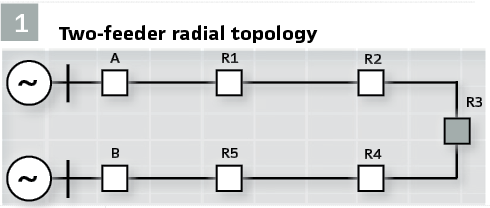
Non-communication FLISR is most effective on two-feeder radial loops (or simple open-loop configurations common in suburban and rural distribution.) A classic example is shown in Figure 1.
R1 and R2 are normally closed; R3 is normally open. Loads are distributed along the sections. The system is radial under normal conditions (no circulating currents). Recloser controls are programmed identically or symmetrically with local automation logic enabled.
Detailed Operational Sequence for a Permanent Fault:
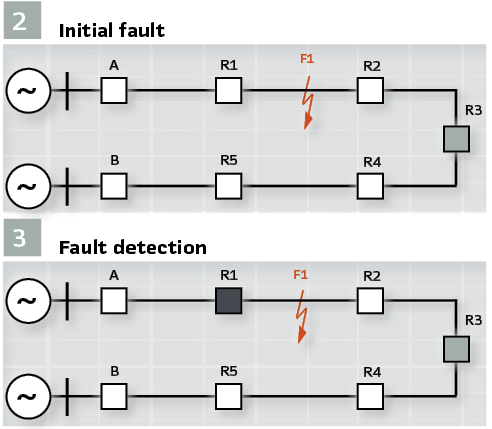
Assume a permanent phase-to-ground fault occurs in Section 2 between R1 and R2 (see Figure 2.)
1. Fault detection and upstream lockout: R1 detects the fault current, trips open on its instantaneous or time-overcurrent element and initiates its reclose sequence (typically 2–4 shots). After unsuccessful recloses, R1 locks out (open). The entire downstream feeder (including Section 1, R2, and Section 2) becomes de-energized. Customers on Feeder A experience a momentary interruption followed by sustained outage. (See Figure 3.)
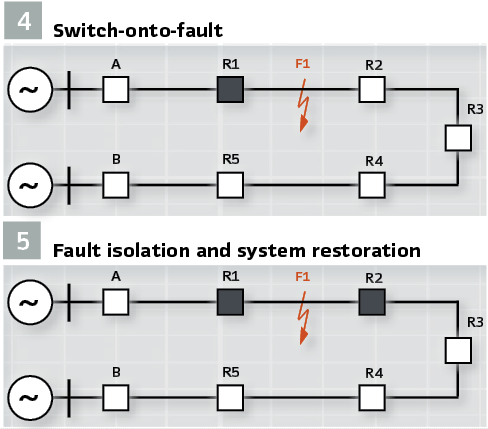
2. Voltage-loss detection at tie point: R3, monitoring its line-side voltage (the side toward R2), sees a sustained undervoltage (below ~80 % nominal for several seconds). After its programmed delay (calibrated longer than R1’s full reclose cycle plus margin, e.g., 30–60 seconds), R3 automatically closes. This re-energizes Section one and Section two from the alternate source (Feeder B). At this instant, R3 is closing directly onto the permanent fault-hence the term “Switch-onto-fault logic.” (Figure 4.)
3. Downstream isolation: R2 now sees fault current flowing through it (from the newly energized direction). Its overcurrent elements (instantaneous 50 or definite-time 51) pick up immediately, trip R2 open, and lock it out (after any remaining reclose attempts). Because R2 is now open and R1 is already locked out, the faulted Section 1 is isolated between R1 and R2, while R3 has successfully back-fed up to R2. (See Figure 5.)
4. Restoration complete: All customers upstream of R1 remain on Feeder A (minus the faulted section). Customers between R2 and R3 (and beyond if extended) are now restored from Feeder B via R3. Only the customers directly on the faulted segment remain out. The entire sequence completes in under one minute, compared to hours for manual switching.
This implicit coordination works because the power system’s natural behavior (voltage collapse propagating downstream, fault current only flowing when the tie closes) provides the “signaling” that communications would otherwise supply.
Advantages of the Non-Communication Approach:
- Zero communications infrastructure cost and complexity: No radios, fiber, cellular modems, or cybersecurity hardening required. Ideal for rural feeders or utilities with limited budgets
- Ultra-high reliability: The system works even if all communications fail (e.g., during major storms). Devices continue to operate on local measurements alone
- Sub-minute restoration: Significantly improves SAIDI, SAIFI, and Customer Minutes Interrupted (CMI) indices without operator intervention
- Scalability to high-density deployments: When combined with non-communication high-density coordination (tight TCC settings and many reclosers per feeder), fault isolation becomes very granular
- Simplicity and maintainability: Logic is contained entirely within each device; settings are verified locally with standard relay test sets
Limitations and Considerations:
- Topology restriction: Best for simple two-feeder loops or open-loop designs. Complex multi-feeder meshes or systems with many laterals require centralized or communications-based FLISR for optimal restoration paths and load-flow validation
- Brief fault energization: The Switch-onto-fault step imposes momentary stress on the faulted cable/equipment and upstream source. Modern reclosers are rated for this, but utilities must confirm interrupting capability and coordination studies
- No global optimization: Local logic cannot consider feeder loadings, voltage profiles, or DER impacts across the entire system. It restores “as much as possible” based on the first viable alternate source rather than the absolute best one
- Coordination engineering required: Time delays and TCCs must be rigorously studied; improper settings can cause unnecessary trips or delayed restoration
- Limited to permanent faults: Temporary faults are cleared by normal reclosing; the scheme activates only after lockout
Communications-Based FLISR Systems
Communications-based FLISR relies on explicit data exchange status, fault indicators, switch positions, directional elements, and control commands between field devices or between devices and a central platform. This contrasts sharply with non-communication local-logic schemes, which depend solely on voltage/current measurements and time delays. By using standardized or proprietary protocols, communications-based approaches achieve faster, more precise, and globally optimized restoration, often in milliseconds to tens of seconds, while supporting complex topologies, high distributed energy resource (DER) penetration, bidirectional flows, and integration with broader outage management systems (OMS) or advanced distribution management systems (ADMS).
The primary communications-based FLISR architectures fall into three categories:
1. Peer-to-peer distributed (decentralized)
2. Centralized/regional
3. Hybrid/edge-computing variants
Each leverages different communication technologies, most notably IEC 61850 GOOSE and R-GOOSE for distributed systems, DNP3/IEC 60870-5-104/IEC 61850 MMS/MQTT for centralized and hybrid, and offers distinct trade-offs in speed, resilience, scalability, cost, and optimization capability. Below is a detailed examination of each, including operational principles, protocol usage, benefits, and disadvantages.
Peer-to-Peer Distributed (Decentralized) FLISR:
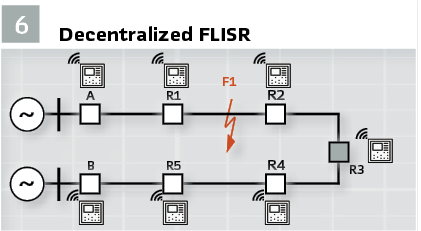
In peer-to-peer distributed FLISR, intelligent electronic devices (IEDs-recloser controls, sectionalizers, bay controllers, or relays installed at substations, mid-feeder points, and normally-open tie (NOP) locations, communicate directly with one another without a central controller.
Communication-based FLISR leverages GOOSE (and R-GOOSE for wider areas) to achieve sub-second fault isolation and service restoration – far faster and more precise than non-communication local-logic schemes. The architecture is fully decentralized: each recloser, sectionalizer, or feeder IED acts as both publisher and subscriber. No central master or DMS is required for core operation (though one may supervise.)

When feeders span multiple substations or involve wide-area coordination (e.g., multiple ties, high DER penetration), native GOOSE is insufficient. R-GOOSE (over utility MPLS, fiber, or QoS-prioritized LTE/5G) carries the same DataSets across WAN links. When a fault in a Substation A feeder is detected locally, the upstream IED publishes R-GOOSE to a remote tie point in Substation B (100+ km away). The remote IED receives the message, validates direction/loading via its local data, and executes remote open/close commands. Security (HMAC/AES via KDC) and QoS ensure latency stays within protection requirements.
GOOSE provides the fast, reliable, “nervous system” for distributed FLISR inside substations, while R-GOOSE extends that intelligence across the wider grid. Together they enable true self-healing distribution systems that operate autonomously, securely, and at speeds impossible with legacy or non-communication approaches. Modern deployments routinely achieve restoration in under 200 ms while maintaining full interoperability across vendors. (See Figure 6.)
A typical sequence in a looped radial feeder proceeds as follows:
- Upstream IED detects fault, asserts forward directional overcurrent, trips, and publishes updated GOOSE (stNum increments)
- Neighboring IEDs instantly compare local measurements with received data: the device seeing forward fault locally + reverse or no fault from downstream neighbor identifies itself as the upstream isolation point and locks out
- Downstream isolation follows symmetrically
- Once both ends of the faulted section confirm isolation via GOOSE, the tie IED receives confirmation + sustained voltage loss and closes without closing onto the fault
- All devices publish final status; healthy sections are restored from alternate sources
Recent tests over LTE/5G with QoS prioritization achieve 20–70 ms latencies, sufficient for protection-grade logic selectivity.
- Benefits of such implementation include:
- Ultra-fast restoration (sub-second isolation, minimal customer minutes lost up to 51% CMI reduction per U.S. DOE studies)
- No single point of failure continues during central system or wide-area comms outages (though native GOOSE is LAN-limited without R-GOOSE)
- Precise sectionalizing using shared directional data; handles bidirectional flow and DER fault contributions
- Eliminates Switch-onto-fault stress on equipment
- Scalable within moderate topologies via SCL configuration; supports multi-agent extensions
- Continuous supervision (timeAllowedToLive) and self-healing fallback to local logic on GOOSE timeout
- Dramatic SAIDI/SAIFI improvement with minimal operator intervention; economic gains from reduced crew dispatch and premium-power revenue
Disadvantages:
- Requires robust, low-latency communications infrastructure (Ethernet switches, VLANs, priority queuing, radios/fiber/LTE); upfront cost and ongoing maintenance higher than non-comms
- Cybersecurity exposure (GOOSE spoofing, DoS; mitigated by VLANs, port security, or full R-GOOSE signing/encryption but adds complexity and minor latency)
- Configuration complexity (SCD files, DataSet mapping, interoperability testing across vendors—ABB, Siemens, SEL, etc.)
- Limited global optimization—no real-time load-flow validation or consideration of feeder overloads across the entire system
- Topology constraints: best for simple-to-moderate loops; struggles with highly meshed networks or multiple simultaneous faults without extensions
- Bandwidth and device density demands; high economic cost for deploying IEDs/reclosers at every section point
- Potential issues with high-resistance earth faults or chattering signals if not properly supervised
Centralized / Regional FLISR:
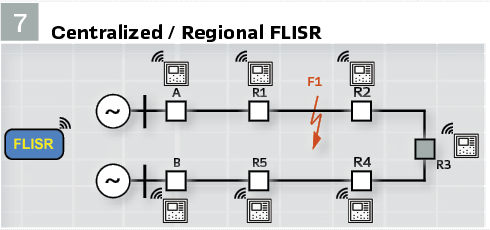
Centralized FLISR aggregates data from field devices (reclosers, sectionalizers, fault passage indicators) into a Distribution Management System (DMS), ADMS, or SCADA platform. Protocols include DNP3, IEC 60870-5-104, IEC 61850 MMS (client-server), or MQTT for polling/reporting. The central engine runs model-based algorithms using GIS topology, real-time telemetry, load estimates, and sometimes synchrophasors or AMI data. (See Figure 7.)
Field devices report fault flags, currents, voltages, and switch status periodically or on change. The ADMS performs:
- Fault location via impedance, traveling-wave, or rule-based methods enhanced by multiple reports
- Isolation optimization (smallest section, considering constraints)
- Service restoration path selection via power-flow analysis, thermal/voltage limits, DER availability, and contingency checks
- Command issuance (open/close) back to devices
Restoration typically takes 10–60+ seconds due to polling latency, processing, validation, and round-trip command time. Operator oversight or semi-automatic modes are common.
Benefits:
- Global optimization: selects the absolute best restoration path considering real-time loadings, voltage profiles, DER injection, and multiple sources superior for complex, meshed, or high-DER networks
- Scalability to system-wide deployment (hundreds/thousands of devices) via a single DMS platform
- Full integration with OMS, crew dispatch, reporting, and regulatory compliance tools
- Rich analytics (load flow, predictive fault location, post-event reporting)
- Versatility for large portions of the grid; real-time grid status visibility at control centers
- Significant reliability gains (up to 45% reduction in customers interrupted, 51% in CMI per DOE data) plus economic benefits from premium-quality service and reduced crew workload
Disadvantages:
- Slower than peer-to-peer (latency from data collection, central processing, and command issuance; network congestion during storms exacerbates this)
- Single point of failure at the central server or backbone communications—complete outage if ADMS or wide-area links fail
- Highest implementation cost: robust two-way communications infrastructure (radio, cellular, fiber), software licenses, GIS model maintenance, and integration
- Dependency on continuous wide-area communications; vulnerable to cyber-attacks on a larger surface
- Potential overload risks if load estimates are inaccurate
- Less resilient during major events when comms degrades
Hybrid / Distributed Edge FLISR:
Emerging hybrid architectures combine peer-to-peer speed and resilience with centralized optimization. Edge devices (low-cost compute modules attached to existing reclosers/RTUs) run lightweight local FLISR logic (e.g., rule-based on Fault Passage Indicators FPI and Loss of Voltage Indicators LVI) while communicating upstream via MQTT or IEC 104 to a central ADMS. When comms are healthy, the central system can override or refine decisions; during outages, edge devices operate autonomously using local topology subsets (graph databases derived from GIS).
Edge logic mirrors distributed rules (open on FPI+LVI for isolation; close NOP on LVI for back-feed) but uses MQTT for bi-directional status/control. Fallback occurs automatically on comms loss. Central oversight provides global view when available. Recent implementations (e.g., Irish grid trials) achieve about 2 ms local execution vs. 200–1000+ ms for centralized over cellular.
Benefits:
- Ultimate resilience: functions independently during comms failure, weather events, or central outages—combining distributed fault tolerance with centralized intelligence
- Near real-time performance in edge mode with optimal paths when central is available
- Cost-effective retrofit (attach to legacy switches/RTUs rather than full replacement)
- Dramatic CML reduction (up to 87.5% in simulations for single-fault cases)
- Scalability across rural/remote areas with poor connectivity; supports multi-fault handling when central assists
- Fault-tolerant and future-proof for DER/microgrids
Disadvantages:
- Increased integration complexity (edge-SCADA-central synchronization, protocol bridging)
- Local edge view may yield sub-optimal decisions without central data (e.g., missed network-wide constraints)
- Effectiveness reduced in highly complex topologies or simultaneous multiple faults
- Additional hardware (edge modules) and training costs requires accurate local topology subsets
- Latency variability in hybrid mode depending on network (5G/4G vs. fallback)
- Still needs reliable (though reduced) communications for full optimization
Conclusions
In summary, FLISR remains essential for reliable distribution but must evolve into adaptive, DER-aware systems-often hybrid distributed-centralized to thrive in renewable-dominated grids. By leveraging communications (GOOSE/R-GOOSE), ADMS/DERMS integration, edge intelligence, and intentional islanding, utilities can turn DER challenges into opportunities for faster restoration, greater resilience, and seamless clean energy integration. As penetration grows toward net-zero targets, these advanced FLISR implementations will be critical for the self-healing, flexible grids of the future.
Biography:
Dr. Alexander Apostolov received his MS degree in Electrical Engineering, MS in Applied Mathematics and Ph.D. from the Technical University in Sofia, Bulgaria. He is Principal Engineer for OMICRON electronics in Los Angeles, CA. He is an IEEE Life Fellow and Member of the IEEE PSRC. He is past Chairman of the Relay Communications Subcommittee and serves on many IEEE PES WGs. He is a member of IEC TC57 WGs 10, 17 and 19, Convenor of CIGRE WG B5.86 and member of several other CIGRE B5 WGs. He is a Distinguished Member of CIGRE. He holds 5 patents and has authored and presented more than 650 technical papers. He is an IEEE Distinguished Lecturer. He is Member of the US National Academy of Engineering and Editor-in-Chief of PAC World Magazine.